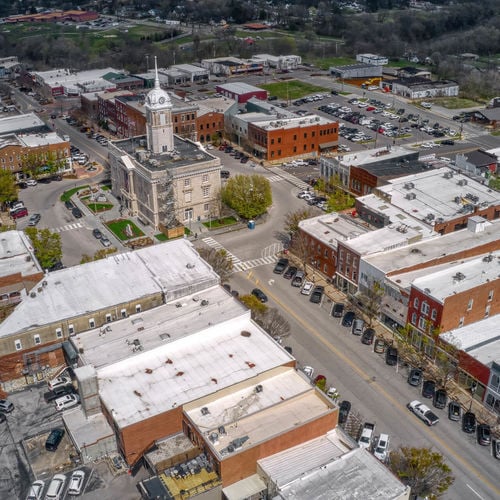



Quick answer (as of October 2026): Downtown Columbia, TN is built around the Public Square and the Maury County Courthouse, built in 1904 and 1905. Within a few blocks are the President James K. Polk Home and the Athenaeum Rectory. The city has five local historic overlay districts, and under design guidelines adopted June 11, 2026, exterior work beyond routine maintenance on a home in one of them needs a Certificate of Appropriateness before it starts. Mule Day is set for April 1 to 3, 2027.
If you've fallen for an older house near the square in Columbia, you've probably got two questions. What's it like to live downtown? And what am I allowed to change on the outside once I own it?
I own a renovated historic home near the square in Columbia, so I can answer both from experience. I've been selling real estate since 2013 and investing in real estate since 2005, and an old house is a different purchase from a new one. Here's what you should know before you write an offer.
What's in downtown Columbia, TN?
Downtown Columbia, TN is the Public Square, the Maury County Courthouse in the middle of it, and the blocks of older commercial buildings, churches and homes around it. The courthouse was built in 1904 and 1905 to a design by Carpenter & Blair: three stories of stone in the Neo-Classical style, with an octagonal lantern and clock on top and Doric porticoes on the east and west sides. It replaced an 1846 brick courthouse.
The blocks around it make up the Columbia Commercial Historic District, listed on the National Register of Historic Places in 1984. When it was nominated, the district counted 91 buildings dating from the 1820s to the 1940 U.S. Post Office and Court House, mostly brick, one to four stories, with Victorian and early 1900s commercial buildings around the square itself.
Today the square is ringed by shops and restaurants, and it's where downtown's events happen. First Fridays run every first Friday from April through December, 5 to 8 p.m., with live music, food trucks, a vendor market and shops open late. For the event, West 7th, South Main and the whole Public Square close to traffic. If you're buying within a few blocks, plan your Friday evenings around it, or plan to walk over.
What is Columbia Main Street?
Columbia Main Street is downtown Columbia's revitalization program, run by the nonprofit Columbia Main Street Corporation, and it runs First Fridays in partnership with the City of Columbia. Main Street America called Columbia an accredited Main Street community in February 2025. The city calls it one of the state's first six accredited Main Street communities, and in 2026 it was one of eight semifinalists for the Great American Main Street Awards.
What is the Athenaeum in Columbia, TN?
The Athenaeum Rectory, at 808 Athenaeum Street in Columbia, was built in the 1830s by Nathan Vaught, a Maury County master builder, and mixes Gothic and Moorish details. It became part of the Athenaeum, a girls' school the Rev. Franklin Gillette Smith founded next door in 1852, and it's the last building left from that campus.
The Smiths deeded it in 1973 to the Association for the Preservation of Tennessee Antiquities, and it was listed on the National Register the same year. Today it's a house museum. The streets around it form the Athenaeum Historic District, one of the city's five local historic overlays.
What is the James K. Polk Home?
The President James K. Polk Home, at 301 West 7th Street in Columbia, was built by Polk's father, Samuel Polk, in 1816. Not counting the White House, it's the only surviving residence of the 11th president. It sits just west of the square, with the Polk Sisters' House right next door.
It's a National Historic Landmark, owned by the State of Tennessee and run by the nonprofit James K. Polk Memorial Association. Walk-in tours run daily.
When is Mule Day in Columbia?
Mule Day 2027 is set for April 1 to 3 in Columbia. The tradition goes back to the 1840s, when it started as Breeder's Day, a one-day mule market on the first Monday in April. The first official Mule Day, with a parade and a mule show downtown, was in 1934.
Now it runs several days, and the Saturday parade is the highlight. Check the official site for the 2027 schedule and the parade route.
What are Columbia's historic districts?
Columbia has two kinds of "historic district", and the difference matters when you own a house in one.
A National Register district is an honor. Columbia has three around downtown: the Columbia Commercial Historic District (listed 1984), the West Sixth and Mayes Place Historic District (1978) and the Columbia West End Historic District (1986). Under federal law, a National Register listing by itself puts no restrictions on what a private owner does with the house.
A local historic overlay district is part of the city's zoning, and it does carry rules. Columbia has five:
- Athenaeum
- Barrow Court
- Downtown Commercial
- West 6th Street/Mayes Place
- West 7th Street/West End
The city's Historic Zoning Commission reviews exterior work in them, and Columbia has been a Certified Local Government, a local, state and federal preservation partnership, since 2001. The periods the city recognizes vary by district: West 6th Street/Mayes Place runs from 1820 to 1930, and Barrow Court from the 1910s to the 1940s.
What does historic zoning mean for my home's exterior?
In Columbia's five overlay districts, the city's design guidelines, adopted by the City Council on June 11, 2026, sort exterior work into three groups.
| Type of work | What it covers | Who approves it |
|---|---|---|
| Routine maintenance | Repairing a material or feature to fix deterioration or damage, with no change in design, material or appearance. Painting non-masonry items is in this group too. | No review needed |
| Minor project | Work that doesn't substantially change how the property looks, like in-kind or compatible replacement of roofing, siding, windows and doors, or minor site work | City staff, when they can tell it meets the guidelines; otherwise the Historic Zoning Commission |
| Major project | A substantial change in appearance: a change in exterior materials, new construction, signage, moving a building or demolition | The Historic Zoning Commission, at a public meeting |
The approval is called a Certificate of Appropriateness, and you need it before the work starts. It's valid as long as the project starts within a year. Starting without one can bring fines or a stop work order.
If the commission turns a project down, you can revise it and resubmit, or apply for an economic hardship exemption if it applies. If you believe the rules and procedures weren't followed, you can appeal to the Maury County Chancery Court.
A few specifics from the guidelines:
- Masonry that's historically been painted should stay painted, and painting brick that was never painted is prohibited.
- A replacement window has to match the original in size, shape, profile, pane arrangement and operation, and you can't resize the opening to fit a new unit.
- The guidelines don't regulate your interior unless the work changes the outside. They don't restrict selling or renting the house, and they don't dictate a brand or product.
Buildings in a district are also classed as contributing or non-contributing. A contributing building dates to the district's historic period and keeps its character, and it's held to a higher standard. A non-contributing one, like a 1980s infill building, gets more leniency.
What should I know before buying a historic home near the square?
Before buying a historic home near the square in Columbia, find out whether it's in one of the five overlays and what that means for the work you have in mind.
- Confirm the overlay before you write the offer. Text me the address and I'll tell you if it's in a district.
- Price your plans with the review step in mind. A new roof in the same material is a minor project, which city staff can approve when it clearly meets the guidelines. Different siding or a new addition is a major project for the commission. Development Services staff can talk through which group your project falls into.
- Get an inspector who knows old houses. An older home can look great and still need real money in places a newer one never would, and you want that number before you close.
- Look at the house's own history. Whether it counts as contributing affects how much room you have to change the exterior.
Why talk to me about a home near the square?
I own a renovated historic home near the square in Columbia, so I've been through what the work on an old Columbia house takes. I'll pull the closed sales near the square, ask the city about the overlay for the exact address, and tell you what I see on the walk-through.
Selling one? Start with my home value request. For the rest of the city, see my Columbia, TN guide, and my guide to living in Columbia covers taxes, utilities and the commute.
Buying or selling a historic home near the square in Columbia? Text me the address and I'll tell you if it's in a district and what the overlay means for exterior changes. DM, text or call me at 615-392-1186.
Frequently asked questions
What is downtown Columbia, TN known for?
The Public Square and the Maury County Courthouse, built in 1904 and 1905, plus the James K. Polk Home on West 7th Street, the Athenaeum Rectory, First Fridays from April through December, and Mule Day each spring. The blocks around the square are the Columbia Commercial Historic District on the National Register.
What are the historic districts in Columbia, TN?
Columbia has five local historic overlay districts: Athenaeum, Barrow Court, Downtown Commercial, West 6th Street/Mayes Place, and West 7th Street/West End. Three areas downtown are also on the National Register: the Columbia Commercial, West Sixth and Mayes Place, and Columbia West End historic districts.
Do I need permission to change the outside of a historic home in Columbia?
If the home is in one of the five local overlay districts, yes for most exterior work. Routine maintenance and painting non-masonry items need no review. Minor projects like in-kind roof, siding or window replacement can be approved by city staff, and major projects like new construction, new materials or demolition go to the Historic Zoning Commission. Get the Certificate of Appropriateness before work starts.
Does Columbia's historic zoning control the inside of my house?
No. The city's design guidelines don't regulate interior changes unless they affect the exterior, and they don't restrict selling or renting the house.
When is Mule Day 2027?
April 1 to 3, 2027, according to the event's official site. Mule Day dates back to the 1840s, and the Saturday parade is the highlight.
Is Columbia, TN a Main Street community?
Yes. Main Street America called Columbia an accredited Main Street community in February 2025, and the city calls it one of Tennessee's first six accredited Main Street communities. Columbia Main Street runs First Fridays with the City of Columbia.
Can I tour the James K. Polk Home?
Yes. The President James K. Polk Home and Museum at 301 West 7th Street offers walk-in tours daily. It was built in 1816 by Samuel Polk and is the only surviving residence of President Polk other than the White House.
Buying or selling a historic home near the square in Columbia? Text me the address and I'll tell you if it's in a district and what the overlay means for exterior changes. DM, text or call me at 615-392-1186.
Check out this article next