

Quick answer (as of November 2026)
The Gulch is a 91-acre neighborhood on the west side of downtown Nashville, in Davidson County, between Broadway and Interstate 40, built on the city's old rail yard. Nearly every home there is a condo or an apartment: Metro's parcel records show about 1,150 condo units in the district, almost all in five buildings. For 2026 a Gulch home pays Nashville's Urban Services District rate of $2.814 per $100 of assessed value plus a Gulch district levy of $0.1081, and Lower Broadway at 5th Avenue is a 13 to 21 minute walk.
Property tax figures are the county and city rates published for the year shown and are for planning only. Your actual bill depends on the assessed value, any exemptions and the city or district the home sits in. Confirm with the county assessor or trustee and your tax professional before you rely on a number.
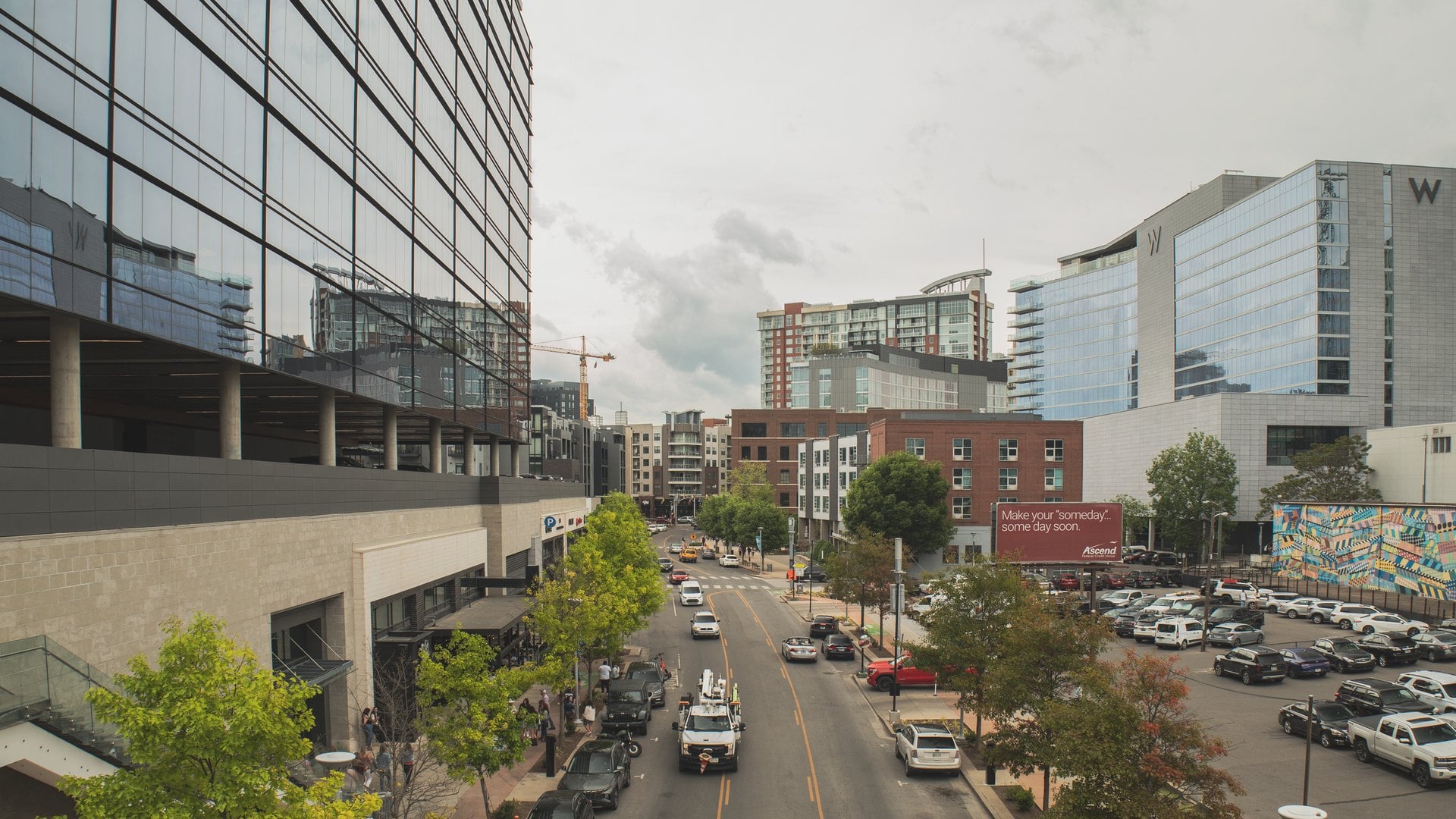
Every photo of the Gulch shows the same rooftops and the same mural. None of them shows what you'd live with after you close: an association budget, a second line on your tax bill, a parking space that may or may not come with the unit, and an interstate on two sides.
I made the move from California to Middle Tennessee myself, and I live in Canterbury in Thompson's Station. Here's where the Gulch's lines run, what's built there and what owning a condo there costs, from Metro's own records, as of November 2026.
Where is the Gulch in Nashville?
The Gulch is on the west side of downtown Nashville in Davidson County, south of Broadway and north of Interstate 40, between downtown and Music Row. It's part of Metro Nashville, not a separate city, and its mailing ZIP is 37203.
Metro's 2015 ordinance for the Gulch business district draws the core from 13th Avenue South and Broadway, east along Broadway to the CSX rail line, down the tracks to Interstate 40 and back along the interstate. On Metro's parcel map, the district's tax code also covers the Division Street blocks east of the tracks out to about 7th Avenue South. The Gulch district says it covers all 91 acres, and the Nashville Downtown Partnership puts the population at about 9,000.
To check a specific address, look it up on Metro's Parcel Viewer. A Gulch parcel carries its own district code, which matters for the tax bill further down. For the rest of the city, start with my Nashville guide.
Why is it called the Gulch?
The Gulch is named for the land itself, a natural low spot below downtown that the railroads filled with track. The Cultural Landscape Foundation says five train lines ran through it by 1861, and by 1896 it was a rail yard with about three dozen tracks.
The Nashville Historical Foundation notes that the old Kayne switchyard was named for Kayne Street, which is now 11th Avenue. After passenger trains stopped in the late 1970s, the foundation says the yard became a train graveyard of sorts.
According to the Gulch district, the area sat largely undeveloped for nearly 50 years after World War II, until the Turner family took ownership of the land in the early 2000s. Metro created the Gulch business improvement district in 2006, the rebuild followed a master plan by Urban Design Associates, and the 22-story ICON tower went up in 2008. The district calls itself the first neighborhood in the South with LEED certification for Neighborhood Development.
What's in the Gulch?
The Gulch packs restaurants, a grocery store, a bluegrass room and three small parks into 91 acres. The district's directory lists 62 places to eat as of November 2026, including Biscuit Love at 316 11th Avenue South, Adele's at 1210 McGavock Street and Peg Leg Porker at 903 Gleaves Street.
Turnip Truck, a Nashville grocer, has its Gulch store at 321 12th Avenue South, so you can buy groceries on foot. The Station Inn at 402 12th Avenue South books bluegrass, classic country, Americana and roots music. For green space, the district lists Gulch Dog Park, Grace's Alley and Noble Park, and the What Lifts You mural is in the Gulch too.
Is the Gulch walkable to Broadway?
Yes. Lower Broadway at 5th Avenue is 0.6 mile, about a 13-minute walk, from 11th Avenue and Demonbreun Street at the north end of the Gulch, and 1.0 mile, about 21 minutes, from 12th Avenue South and Division Street at the south end.
Walks were measured on November 5, 2026 with OpenStreetMap foot routing, and drives with OpenStreetMap car routing with no traffic, so treat each drive as the floor.
| From the Gulch to | How | Distance | Time |
|---|---|---|---|
| Lower Broadway at 5th Avenue, from 11th Ave and Demonbreun St | Walk | 0.6 mi | 13 min |
| Lower Broadway at 5th Avenue, from 12th Ave S and Division St | Walk | 1.0 mi | 21 min |
| Broadway at 21st Avenue, toward Midtown, from either point | Walk | 1.0 mi | 21 min |
| Nashville International Airport (BNA) | Drive, no traffic | 7.7 mi | 12 min |
| CoolSprings Galleria, Franklin | Drive, no traffic | 15.1 mi | 20 min |
| Franklin's Public Square | Drive, no traffic | 20.4 mi | 25 min |
| Thompson's Station Town Hall | Drive, no traffic | 29.4 mi | 36 min |
Drives start at 12th Avenue South and Division Street.
For buses, WeGo's Route 17, 12th Avenue South, stops at 11th Avenue and Laurel Street, 11th Avenue and Demonbreun Street, and 12th Avenue South and Division Street. Route 8, 8th Avenue South, stops at 8th Avenue South and Division Street on the east side. That's from WeGo's fall 2026 schedule.
If you'll work in Franklin or Cool Springs, see how far Franklin is from Nashville and my guide to where to live in Nashville by commute and tax.
Is parking hard in the Gulch?
Parking in the Gulch is mostly private garages and lots, plus metered street spaces that Metro runs. The district's parking guide lists street parking at $2.25 an hour around the clock with a three-hour limit, and in Gulch East it's three hours until 5 PM and seven hours after.
The garages and lots are privately owned, and MarketStreet posts their rates on its own map, linked from the Gulch parking guide. Even the Station Inn tells guests that "Parking in The Gulch can be difficult."
If you're buying a condo, get it in writing before your offer is final: whether a parking space comes with the unit, how many, whether it's deeded or assigned, and what guests do.
What kind of homes are in the Gulch?
Nearly every home in the Gulch is a condo or an apartment in a mid-rise or high-rise building. Metro's parcel records show about 1,150 condo units in the district, and five buildings hold almost all of them.
| Condo building | Address | Name on Metro's records | Condo units on Metro's parcel records |
|---|---|---|---|
| ICON | 600 12th Avenue South | Icon in the Gulch | 411 |
| Pullman at Gulch Union | 1212 Demonbreun Street | Pullman Condominium | 300 |
| Twelve Twelve | 1212 Laurel Street | Twelve Twelve, a Condominium | 286 |
| Terrazzo | 700 12th Avenue South | Terrazzo, a Condominium | 117, plus office and retail units |
| The James | 1002 Division Street | 1000 Division Street Condominium | 31 |
Building names and addresses are the Gulch district's. Unit counts are residential condo parcels on Metro's records as of November 2026.
The rest of the housing is rental. Metro's records list high-rise apartment buildings at Albion in the Gulch (645 Division Street), Aspire Gulch (805 Division Street), Crossroads at The Gulch (803 Division Street), Modera Gulch (810 Division Street), Camden Gulch (908 Division Street), Laurel House Lofts (1101 Laurel Street), Pine Street Flats (1055 Pine Street), Mercury View Lofts (1209 Pine Street) and Prima at Paseo South Gulch (620 8th Avenue South).
Price in the Gulch depends on the building, the floor, the view and whether parking comes with the unit, so I'll pull the recent closed sales in the building you like rather than lean on a neighborhood average.
What should I check in a Gulch condo's HOA documents?
Each Gulch condo building has an owners' association, and its assessment is part of your monthly cost on top of the mortgage and the tax bill. Tennessee law lets you see the association's numbers before you close: under Tenn. Code § 66-27-502, the association has to answer a written request from a buyer, owner or lender within 10 business days, and you're entitled to rely on what it sends.
Section 66-27-503 lists what that packet covers. Here's what I'd read first:
- The unit's current monthly assessment, any special assessment and any amount past due.
- The budget and the amount set aside for repairs and replacements, plus whether a reserve study exists.
- Insurance coverage, limits and deductibles.
- Lawsuits pending against or filed by the association.
- Total assessments more than 60 days past due across all units.
- Transfer fees and any extra fees for amenities.
- Whether the developer still controls the board, and when that ends.
The rules are in there too, so read them for anything you'd do with the unit, like pets, rentals or move-in reservations. I've been selling real estate since 2013 and investing since 2005, and the association packet is where condo surprises show up.
Send me the Gulch building you're looking at, and I'll request the association's resale information on the unit, the current assessment and the parking setup before you write an offer. DM, text or call 615-392-1186.
What are property taxes in the Gulch?
A Gulch home pays Davidson County's 2026 Urban Services District rate of $2.814 per $100 of assessed value, plus the Gulch district levy of $0.1081 per $100, which Metro set in 2017. Homes are assessed at 25% of appraised value, so a $500,000 condo is $125,000 assessed and owes about $3,518 in Metro tax and about $135 for the district, about $3,653 a year.
| Line on the bill | Rate per $100 assessed | On a $500,000 condo ($125,000 assessed) |
|---|---|---|
| Metro Nashville, Urban Services District, 2026 | $2.814 | $3,517.50 |
| Gulch business district levy, through December 31, 2026 | $0.1081 | $135.13 |
| Total for 2026 | $2.9221 | $3,652.63 |
| Downtown business district levy, from January 1, 2027 | $0.1294 | $161.75 |
Metro's budget says the district pays for cleaning crews, landscaping and other services on top of regular Urban Services District service. The levy shows up on the same notice as your property tax, and the Metro Trustee collects it.
Under Metro ordinance BL2025-846, passed July 15, 2025, the Gulch district ends December 31, 2026, and on January 1, 2027 the Gulch becomes part of an expanded Downtown Central Business Improvement District. The ordinance sets the downtown levy at $0.001294 per dollar of assessed value, which is the $0.1294 per $100 in the last row, until the Metro Council changes it.
The Urban Services District rate covers services like garbage pickup, street lights and sidewalks, per the Davidson County Assessor. My cost of living in Nashville guide has the full monthly picture.
Property tax figures are the county and city rates published for the year shown and are for planning only. Your actual bill depends on the assessed value, any exemptions and the city or district the home sits in. Confirm with the county assessor or trustee and your tax professional before you rely on a number.
How noisy is the Gulch?
Noise in the Gulch depends on which way your windows face. Interstate 40 runs along the south and west edges, the CSX rail line runs through the district, and rooftop bars and music rooms sit among the condo towers.
The district's directory lists UP Rooftop at 901 Division Street, COA Rooftop at 920 Division Street and Rudy's Jazz Room at 809 Gleaves Street, along with the Station Inn on 12th Avenue South. Tour the unit you like on a weekend night as well as a weekday afternoon, stand at the window, and ask the association about any rules on noise and quiet hours.
Can I see a Gulch condo before I move?
Yes. If you're buying from another state, I'll record a video walkthrough of any Gulch condo you're serious about and send you an unlisted YouTube link you can rewatch as often as you need.
Here's how I work with relocation buyers. For the move itself, start with moving to Nashville, and read the pros and cons of living in Nashville. If you want condo living with Williamson County's tax rates, compare Franklin condos and townhomes, my notes on buying a condo in Franklin and my Thompson's Station guide.
Tell me which Gulch buildings you're weighing and what you want to spend, and I'll come back with the association details, the parking setup and the tax line on each one. DM, text or call 615-392-1186, or use the form below.
Frequently Asked Questions
Where is the Gulch in Nashville?
The Gulch is on the west side of downtown Nashville in Davidson County, south of Broadway and north of Interstate 40, between downtown and Music Row. It's part of Metro Nashville, not a separate city, and its mailing ZIP is 37203.
Why is it called the Gulch?
The Gulch is named for the land itself, a natural low spot below downtown that the railroads filled with track. The Cultural Landscape Foundation says five train lines ran through it by 1861, and by 1896 it was a rail yard with about three dozen tracks.
Is the Gulch walkable to Broadway?
Yes. Lower Broadway at 5th Avenue is 0.6 mile, about a 13-minute walk, from 11th Avenue and Demonbreun Street at the north end of the Gulch, and 1.0 mile, about 21 minutes, from 12th Avenue South and Division Street at the south end.
What kind of homes are in the Gulch?
Nearly every home in the Gulch is a condo or an apartment in a mid-rise or high-rise building. Metro's parcel records show about 1,150 condo units in the district, and five buildings hold almost all of them.
What are property taxes in the Gulch?
A Gulch home pays Davidson County's 2026 Urban Services District rate of $2.814 per $100 of assessed value, plus the Gulch district levy of $0.1081 per $100, which Metro set in 2017. Homes are assessed at 25% of appraised value, so a $500,000 condo is $125,000 assessed and owes about $3,518 in Metro tax and about $135 for the district, about $3,653 a year.
Is parking hard in the Gulch?
Parking in the Gulch is mostly private garages and lots, plus metered street spaces that Metro runs. The district's parking guide lists street parking at $2.25 an hour around the clock with a three-hour limit, and in Gulch East it's three hours until 5 PM and seven hours after.
Property tax figures are the county and city rates published for the year shown and are for planning only. Your actual bill depends on the assessed value, any exemptions and the city or district the home sits in. Confirm with the county assessor or trustee and your tax professional before you rely on a number.
Check out this article next