


Somebody told you that you can use your VA loan to buy rental property with zero down. Half of that is true. The other half can cost you your benefit, because when you close a VA loan you sign a certification that you're going to live in the home.
So here's the honest version. A VA loan is not an investment property loan. It's a loan for the home you live in. But there are three legitimate ways to use it to start building rental income. I'm Kimo Quance, Coast Guard veteran and Realtor with eXp Realty, and I run a 91-door investment portfolio, so this is the corner of real estate I actually live in. If you want the bigger picture on buying here with your benefit, start with my guide to buying a home in Franklin with a VA loan. Or skip the reading and call or text me at 615-392-1186.
Can You Use a VA Loan to Buy an Investment Property in Tennessee?
Not a pure investment property, no. The VA lists three things that all have to be true for a VA-backed purchase loan. You qualify for a Certificate of Eligibility. You meet the VA's and your lender's credit and income standards. And you will live in the home you're buying with the loan. That last one isn't fine print. It's the whole deal.
Tennessee doesn't change it. The VA home loan is a federal benefit, so the occupancy rules are the same in Franklin, Spring Hill, or Columbia. What you can do is buy a home you'll genuinely live in that also produces income, now or later.
What Does "You Have to Live There" Actually Mean?
You certify that you intend to personally occupy the home, once when you apply and again at closing. The VA's lender handbook defines a "reasonable time" to move in as within 60 days after closing. It can run longer only with a specific move-in date tied to a specific future event, like a retirement date that's already set. More than 12 months after closing generally can't be considered reasonable.
If you're on active duty and can't move in yourself, your spouse moving in can satisfy the requirement, and in some cases a dependent child can too.
What I won't do is hand you a made-up number for how long you have to stay before you move out and rent it. What matters is that your intent was real when you signed and you actually lived there. Your lender will tell you exactly what they need to see.
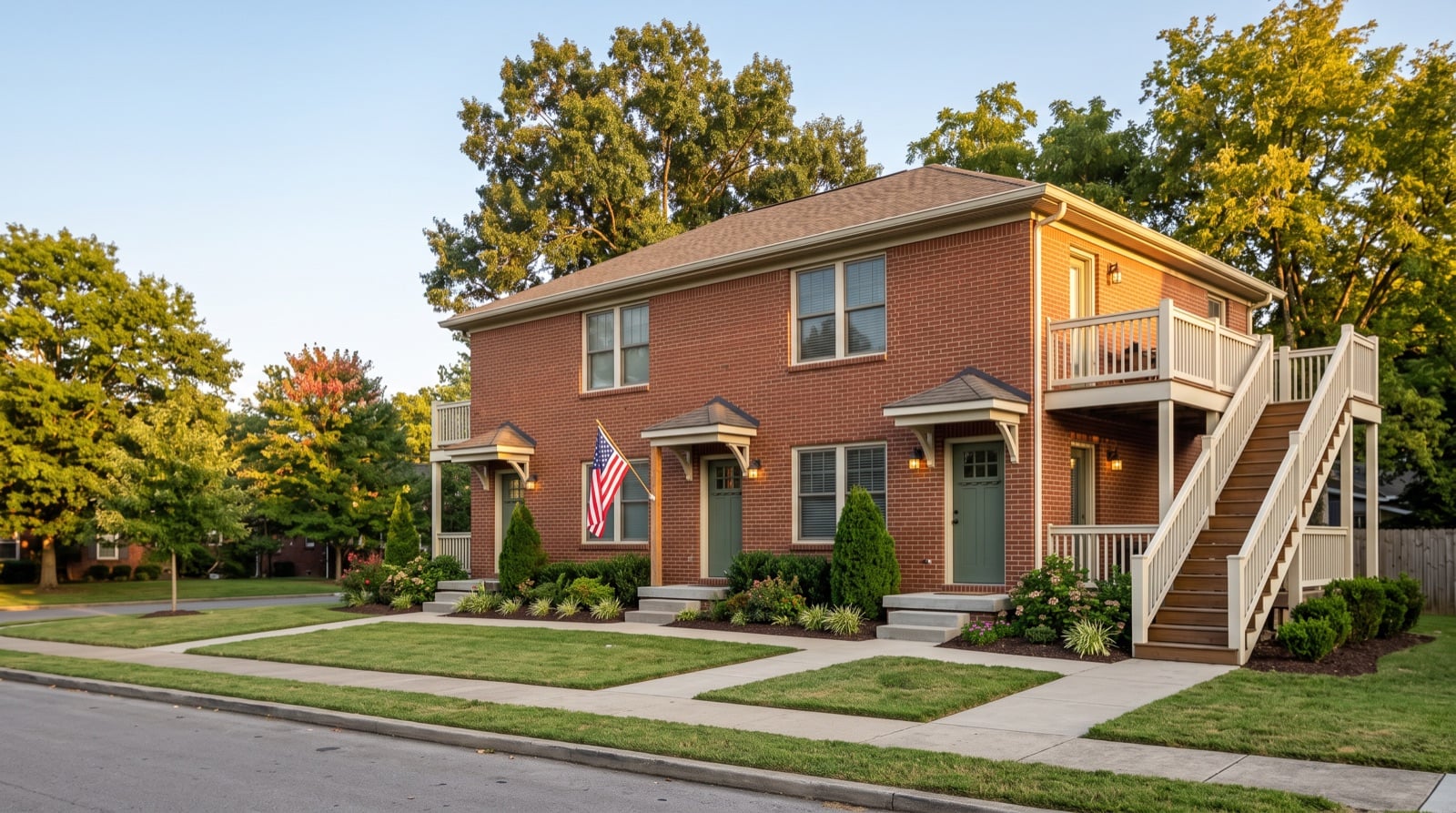
Path 1: House Hacking With a VA Loan (Buy 2 to 4 Units, Live in One)
This is the one that surprises people. The VA lets you buy a home with up to 4 units. You live in one and rent out the others, with the same benefit you'd get on a single-family home: no down payment as long as the sales price isn't higher than the appraised value, and no private mortgage insurance.
Here's the part the YouTube guys skip. If you want the rent from the other units to help you qualify, the VA's lender handbook asks for more:
- Documented experience managing rental units, or a property management company lined up to run it.
- Cash reserves of at least 6 months of mortgage payments. Your own money, not a gift, and not equity in the property.
- The lender counts 75 percent of the lease rent, not 100 percent, unless a higher percentage can be documented.
If you can qualify for the payment on your own income without the rent, the landlord experience and reserve requirements don't apply.
What This Looks Like in Nashville
Here's a real one. A quadplex listed in August in the McMurray Place area of south Nashville, near Brentwood, asking $599,900. Four units, each one bed and one bath, about 2,212 square feet total, built in 1983. The listing shows a new roof, windows, balconies and stairs already done, and the current rents are $995, $995, $970 and $1,095 a month.
I don't take a listing's rent numbers on faith, so I ran one of the units through RentCast, the tool I use to check what a property will actually rent for. It came back at $1,060 a month, with a range of $890 to $1,230 based on nearby one-bedroom rentals. So the current rents are right in line with the market, with a little room to grow.
Now run it through the VA rules. Say you move into one of the $995 units and rent out the other three. That's $3,060 a month coming in. If you need that rent to qualify, your lender counts 75 percent of it, so $2,295 a month goes on your side of the ledger. You'd also need six months of mortgage payments in reserves, plus landlord experience or a property manager lined up. And budget for the rest of what it costs to own it: the listing shows about $8,300 a year in operating expenses, and taxes run about $3,500 a year.
Then ask your lender for the full monthly payment at today's rates and set it next to that $3,060. That gap is the whole story of house hacking. On a four-unit building, the rent from the other three units can cover a real share of what you'd otherwise pay to live there, and it's the math I'd walk through with you before we ever write an offer.
Based on information from Realtracs® for the period August 19, 2026 through September 13, 2026.
And once you've got tenants, you're a landlord. Fair housing law applies to how you advertise your units and how you choose who rents them.
Path 2: Live in It Now, Rent It Later
This is the simplest path. You buy a home, move in, and live there. Later, new orders or a new job move you, and instead of selling, you keep it and rent it out.
The VA's own lender handbook walks through this exact scenario. A veteran with a VA loan gets transferred to a duty station overseas and rents the home out. That veteran can still refinance with a VA Interest Rate Reduction Refinance Loan, because an IRRRL only requires that you previously lived there.
The honest line: this works because you really did live there. Buying with a plan to move out the week after closing isn't Path 2. It's an occupancy problem.
Path 3: Keep the First Home and Buy the Next With Remaining Entitlement
Entitlement is the part of your loan the VA guarantees. It's what lets you buy with no down payment. When you keep your first VA home as a rental, the entitlement you used stays tied up in that loan. It comes back when the home is sold and the loan is paid in full, or when a qualified veteran assumes your loan and substitutes their own entitlement. You can also restore it one time if you pay the loan in full and keep the home.
If you can't restore it, you may still have remaining entitlement to buy your next home with a VA loan while you keep the first. The VA's guarantee is then based on 25 percent of the county loan limit, minus the entitlement you've already used. If that comes up short for your price, your lender will walk you through what a down payment would need to cover.
Three things to know before you go this route:
- The new home has to be your residence, too. Same occupancy rule as the first time.
- The county matters. The limit is set by the county where the property sits, and Spring Hill straddles both Williamson and Maury counties. Your lender will confirm which limit applies to the exact address.
- Your first home's rent won't make you look richer on paper. On the new loan, it can only offset that home's mortgage payment. Anything above the payment doesn't count as income.
The funding fee is also higher after first use. As of the VA's chart today, it's 2.15 percent for first use and 3.3 percent after, when you put down less than 5 percent. If you receive VA compensation for a service-connected disability, you don't pay it at all.
Where VA Loan Assumptions Fit In
VA loans are assumable, meaning a buyer can take over your loan instead of getting a new one. When you eventually sell a rental, a low-rate VA loan a buyer can take over can be a real selling point. Just know your entitlement only comes back if that buyer is a qualified veteran who substitutes their own. I break this down in VA loan assumptions and the entitlement decision every veteran seller faces.
What You Can't Do With a VA Loan
Straight list, no gray area:
- Buy a property you don't intend to live in. No pure rentals.
- Certify you'll live there when you won't.
- Push your move-in out more than 12 months. The VA generally won't consider that reasonable.
- Buy more than four residential units.
- Count your old house's rent as extra income on your next loan.
If you won't live in the property, the VA loan is off the table and you're having a different financing conversation. I lay out when each loan type wins in VA loan vs conventional in Williamson County.
Key Takeaways
- A VA loan is for a home you live in. Pure investment purchases aren't allowed.
- Plan to move in within 60 days of closing. More than 12 months is generally not reasonable.
- You can buy up to 4 units, live in one, and rent the others.
- You can live in the home now and keep it as a rental when you move.
- Remaining entitlement may let you buy your next home with a VA loan while you keep the first.
Frequently Asked Questions
Can I use a VA loan to buy an investment property in Tennessee?
Not a pure investment property. A VA-backed purchase loan requires that you live in the home you're buying. You can buy a 2 to 4 unit property, live in one unit, and rent the others, or live in a home now and keep it as a rental after you move.
How soon do I have to move in after closing on a VA loan?
The VA's lender handbook defines a reasonable time as within 60 days after closing. Longer can work with a specific move-in date tied to a specific future event, but more than 12 months after closing generally isn't considered reasonable. If you're on active duty, your spouse moving in can satisfy the requirement.
Can I buy a duplex, triplex, or fourplex with a VA loan?
Yes, up to 4 units, as long as you live in one of them. To count rent from the other units toward qualifying, lenders look for landlord experience or a property manager plus at least 6 months of mortgage payments in reserves, and they count 75 percent of the lease rent.
Can I have two VA loans at the same time?
Possibly. If you keep your first VA home, you may still have remaining entitlement to buy your next primary residence with a VA loan. The new home must be where you live, and the funding fee is higher after first use unless you're exempt.
Can I rent out my VA home when I move?
Yes, when you genuinely bought it as your home and lived there. The VA's lender handbook describes a veteran who rents out a VA-financed home after a transfer overseas and can still refinance it with an IRRRL based on previous occupancy.
Ready to Make Your Home Pay You Back?
If you want the home you live in to start building wealth, let's figure out which path fits you before you write an offer. I'll bring the investor's math, and I'll line you up with a VA-savvy lender who can confirm your entitlement and your occupancy timing. Call or text me at 615-392-1186, or book a 15-minute veteran call on my veterans page.