

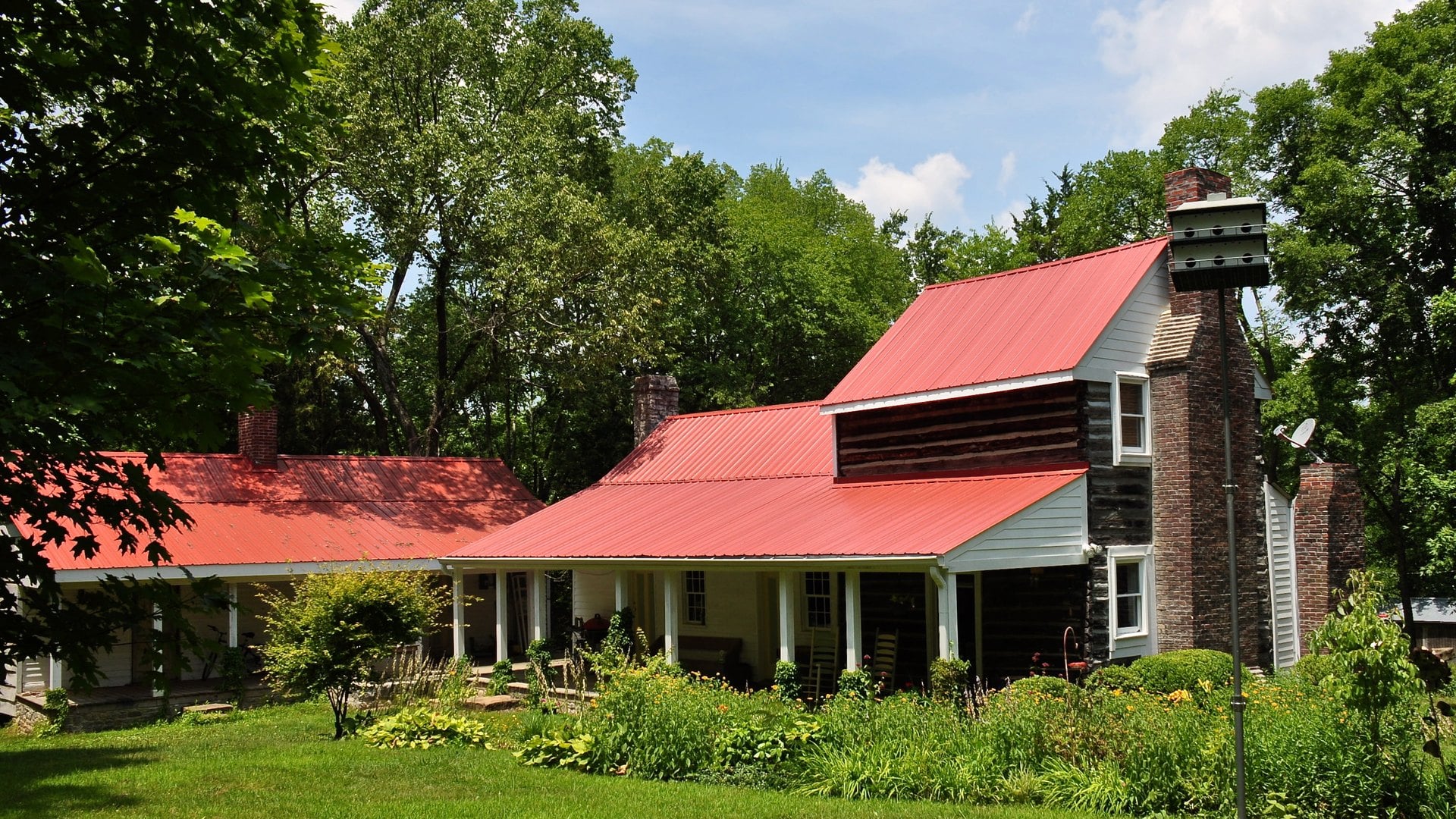
Historic log house in Antioch, Davidson County. Photo: Skye Marthaler, CC BY-SA 3.0, via Wikimedia Commons, cropped.
Quick answer (as of November 2026) A log home or cabin in Middle Tennessee is bought like any other house, with three extra jobs. First, a log-specific inspection, because the U.S. Forest Service says moisture is what leads to decay and insect damage in log homes. Second, a loan and appraisal plan: Fannie Mae accepts log houses as loan collateral when the appraiser has enough market data for a reliable value. Third, the rural checks that usually come with the land: the septic permit, a well water test and legal road access. I work Williamson, Maury and Davidson counties, and I can line all of that up before you're committed.
The cabin looks great in the listing photos. What the photos don't show is the bottom row of logs, the last time anybody stained it, whether the septic was ever permitted and whether that gravel drive crosses somebody else's land. Those are the things that decide whether a log home is a good buy or a money pit, and every one of them can be checked before you're locked in.
I've been in real estate since 2013, I've been part of more than 500 transactions, and I've invested in real estate for more than 20 years, so I read an inspection report the way an owner does. If you're out of state, I'll walk the property on video and send you a recorded link you can rewatch. Text or call me at 615-392-1186 with the listing you're looking at.
Where can I find cabins and log homes for sale in Middle Tennessee?
Start where Middle Tennessee has acreage and rural homes. In Williamson County that's Leiper's Fork, College Grove and the rural western side of the county. In Maury County, look at Culleoka, Santa Fe and the land around Columbia.
Log homes don't always say "log" in the listing headline, and plenty of homes called cabins are frame houses with log siding. Text me the areas and the acreage you want, and I'll send the true log homes as they come up. For land with no house on it yet, see my land for sale in Middle Tennessee page.
What should I inspect on a log home or cabin?
A log home inspection is mostly a hunt for water. Per the U.S. Forest Service's Forest Products Laboratory, logs almost always form deep drying cracks (checks) that let moisture reach the center of the log, and that slow-drying moisture is what sets up decay and insect attack. The Forest Service names the critical areas: the lower parts of windows and doors, the joints, exposed end grain and the lowest two or three logs.
| Where to look | Why, per the Forest Service | What to ask |
|---|---|---|
| The lowest two or three logs | They're the ground splash zone, wet by wind-blown rain and water off the roof | Any soft or stained wood? Has any log been replaced? |
| Log ends at the corners | They often stick out past the roof overhang, and end grain soaks up water | Are the ends sealed? Any decay? |
| Checks (cracks) in the logs | Cracks that face up trap water; builders are told to turn them down | Any upward-facing checks holding water? |
| Joints and chinking between logs | The joints are water-trapping zones and need to be "suitably chinked" | Is the chinking intact, or are there gaps and cracks? |
| Around windows and doors | Water caught in crevices soaks in and dries slowly | Any rot at the sills? Is the caulking current? |
| Roof overhang, gutters and downspouts | A wide overhang is one of the most effective protections; plugged gutters can send water into the structure | How deep is the overhang? Do the gutters drain away from the walls? |
| Foundation height | Good practice puts the bottom logs or sills 12 to 18 inches above the ground on a dry foundation | How far are the bottom logs off the ground? |
| Firewood, plants and sprinklers | Dense plants slow drying, wood piles trap moisture and draw insects, and sprinklers shouldn't spray the walls | Is anything stacked or growing against the logs? |
Insects are the second half of the inspection. The Forest Service lists what to look for:
- Termites. The eastern native subterranean termite is found in every state except Alaska. The common sign is mud shelter tubes on the surface of wood or foundations.
- Carpenter ants. Look for piles of fibrous, sawdust-like material in or around checks and splits.
- Carpenter bees. They make large entrance holes, but their shallow tunnels typically don't cause significant structural damage in logs.
- Powderpost beetles. The first visible sign is usually small round exit holes with fine powder on the wood. The Forest Service calls them the most destructive of the wood-boring beetles in log homes.
I'd add a wood-destroying insect inspection from a pest control company to any log home offer, alongside a general home inspector who has inspected log homes before.
On a newer log home, ask about settling. Logs shrink as they dry, and the Forest Service says windows and doors in a home built with green logs shouldn't be fitted until the logs have dried. Doors that stick, gaps above window frames or stairs pulling away from a wall are worth a question to the inspector.
How often does a log home need to be stained or sealed?
There's no single calendar for it. The Forest Service says penetrating finishes don't blister or peel the way paint and varnish do, so they're easier to maintain, and pigmented stains typically need reapplying less often than clear finishes. It doesn't recommend film-forming varnishes on exposed logs because of their short life in direct sun. Keeping up the exterior finish also lowers the chance of powderpost beetles.
So before you write an offer, I ask the seller when the exterior was last stained or sealed, with what product and by whom, and for any receipts. A log home with records and a recent finish is a different purchase from one that hasn't been touched in years, even at the same price.
Can you get a mortgage on a log home in Tennessee?
Yes, in most cases. Fannie Mae's Selling Guide lists log houses among the "unique or nontraditional types of housing" that are eligible for its loans, as long as the appraiser has enough information to develop a reliable opinion of market value. The appraiser and the underwriter each decide whether there's enough market data.
The hurdle is comparable sales. Fannie Mae doesn't require comparables of the same design, but the appraiser has to show the home is marketable. Where recent log home sales aren't available, Fannie Mae lets the appraiser use older sales, sales in competing neighborhoods or other similar homes in the market area, with adjustments for the differences. Its guide also notes that rural properties often have large lots in relatively undeveloped locations, which makes good comparables harder to find. If the appraiser can't find evidence the market accepts the property, Fannie Mae says the property isn't acceptable for its loans.
Two more rules from Fannie Mae matter on rural property. It doesn't buy loans on agricultural properties such as farms or ranches, or on properties that aren't readily accessible by roads that meet local standards. That's why the use of the land and the road matter as much as the house.
Before you write the offer, we talk about how you'd handle a low appraisal. I can also connect you with a lender for land and rural property who has worked with these appraisals before. Ask any lender, up front, whether they've closed a loan on a log home.
Can I use a USDA loan to buy a cabin in Tennessee?
Sometimes. USDA's Section 502 Guaranteed Loan is for low- and moderate-income buyers purchasing a primary residence in an eligible rural area, with household income that can't exceed 115 percent of the area median, per USDA Rural Development as of November 24, 2026. USDA says the loan can cover "a site with a new or existing dwelling" with no set acreage limits, and the home can't be an income-producing property.
That means a cabin you plan to live in full time can qualify if the address and your income do. A weekend cabin or one you plan to rent out won't. Check any address on USDA's eligibility site at eligibility.sc.egov.usda.gov before you fall for the place, then confirm with a USDA-approved lender. USDA also runs a Section 502 Direct loan for low- and very-low-income buyers who can't get credit elsewhere.
For bare land without a house, see my guide to buying land in Tennessee, which covers land loans, greenbelt and closing.
What should I check on the well and septic?
Get the septic permit record and an inspection of the existing system, and test the well water during your inspection period. If the home isn't on public water and sewer, both systems are yours, and they're expensive to fix after closing.
Septic permits in Tennessee come from different offices by county. Per the Tennessee Department of Environment and Conservation (TDEC), Davidson and Williamson counties run their own septic programs, among the counties that do. TDEC handles Maury County through its Columbia office. TDEC can issue an inspection letter documenting the status of an existing septic system, and it has an online septic records search.
For the well, the U.S. Environmental Protection Agency says to "test your private well annually for total coliform bacteria, nitrates, total dissolved solids, and pH levels." Do that test before closing, and ask your lender early whether they need one too. Fannie Mae requires a home without public water and sewer to have a private well and septic in use, located on the property unless there's a legally binding agreement for access and maintenance of off-site facilities.
Are log homes harder to insure?
It depends on the house and where it sits, so get a quote on the actual address before your inspection period ends. Per the National Association of Insurance Commissioners, "Frame houses usually cost more to insure than brick," and your home's distance from a fire hydrant and the quality of the local fire department set its fire protection class. A rural cabin far from a hydrant can price differently from the same house in town.
The NAIC also says floods aren't covered by a typical homeowners policy. Check the address on FEMA's Flood Map Service Center. Per FEMA, homes in high-risk flood areas with mortgages from government-backed lenders are required to carry flood insurance, and a high-risk area has at least a one-in-four chance of flooding during a 30-year mortgage.
How do I check road access and easements on rural property?
Confirm the home has legal access to a public road, and get it in writing before you close. A gravel drive that's been used for years isn't the same as a recorded easement.
- Look at the survey and the title commitment. Recorded easements, shared driveways and restrictions show up there.
- If the property sits on a private road, find out who maintains it. Fannie Mae requires an adequate, legally enforceable agreement or covenant for maintenance of a privately owned street, unless state law defines what the owners owe.
- If the land has no access at all, Tennessee law lets an owner cut off from a public road ask a court for a private easement up to 25 feet wide, or 15 feet in a county with a metropolitan government such as Davidson. That's a court case, so it's far better to buy a property that already has recorded access.
For more on surveys, zoning and splits, see my land pages for Franklin, Columbia and College Grove.
How I help you buy a cabin or log home
On a log home or cabin, I do five things for you:
- Before the offer, I pull the septic permit record, check the address on the FEMA flood map and USDA's map, and look at the plat and survey for road access.
- I ask the seller for the stain and maintenance history and any repairs to logs or chinking.
- I line up an inspector who has done log homes, a wood-destroying insect inspection, a septic inspection and a well water test inside your inspection period.
- I connect you with a lender for land and rural property and talk through the appraisal plan before you sign.
- If you're out of state, I walk the property on video and send you a recorded link.
Send me the listing you're looking at, and I'll tell you what I'd check first. Text or call me at 615-392-1186.
Frequently asked questions about cabins and log homes
Can you get a mortgage on a log home?
Yes, in most cases. Fannie Mae lists log houses among the unique or nontraditional types of housing that are eligible for its loans, as long as the appraiser has enough market data for a reliable value. The hard part is usually finding comparable sales.
What should I look for when buying a log home?
Water damage and insects. The U.S. Forest Service names the critical areas as the lower parts of windows and doors, the joints, exposed end grain and the lowest two or three logs. Add a wood-destroying insect inspection and check the chinking, the roof overhang and the gutters.
How often does a log home need to be stained?
There's no single calendar. The Forest Service says pigmented stains typically need reapplying less often than clear finishes, and it doesn't recommend film-forming varnishes on exposed logs. Ask the seller when it was last done and with what product.
Are log homes harder to insure?
It depends on the house and the address. The National Association of Insurance Commissioners says frame houses usually cost more to insure than brick, and distance from a fire hydrant and the quality of the local fire department set the fire protection class. Get a quote on the actual address before your inspection period ends.
Can I use a USDA loan to buy a cabin in Tennessee?
Sometimes. USDA's guaranteed loan is for a primary residence in an eligible rural area, with household income that can't exceed 115 percent of the area median, and the home can't be an income-producing property. A full-time home can qualify; a weekend or rental cabin won't.
Do I need a septic inspection when buying a cabin?
Yes. Get the septic permit record and an inspection of the existing system during your inspection period. In Tennessee, Davidson and Williamson counties run their own septic programs, and TDEC's Columbia office handles Maury County.
Ready to look at a cabin or log home?
Send me the listing, and I'll pull the septic record, the flood map and the road access before you're committed. Text or call me at 615-392-1186.
Check out this article next