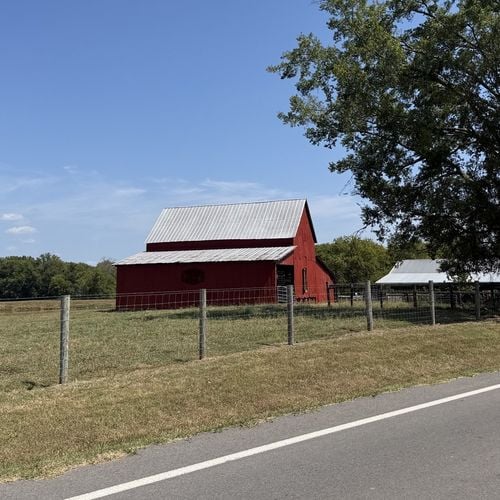


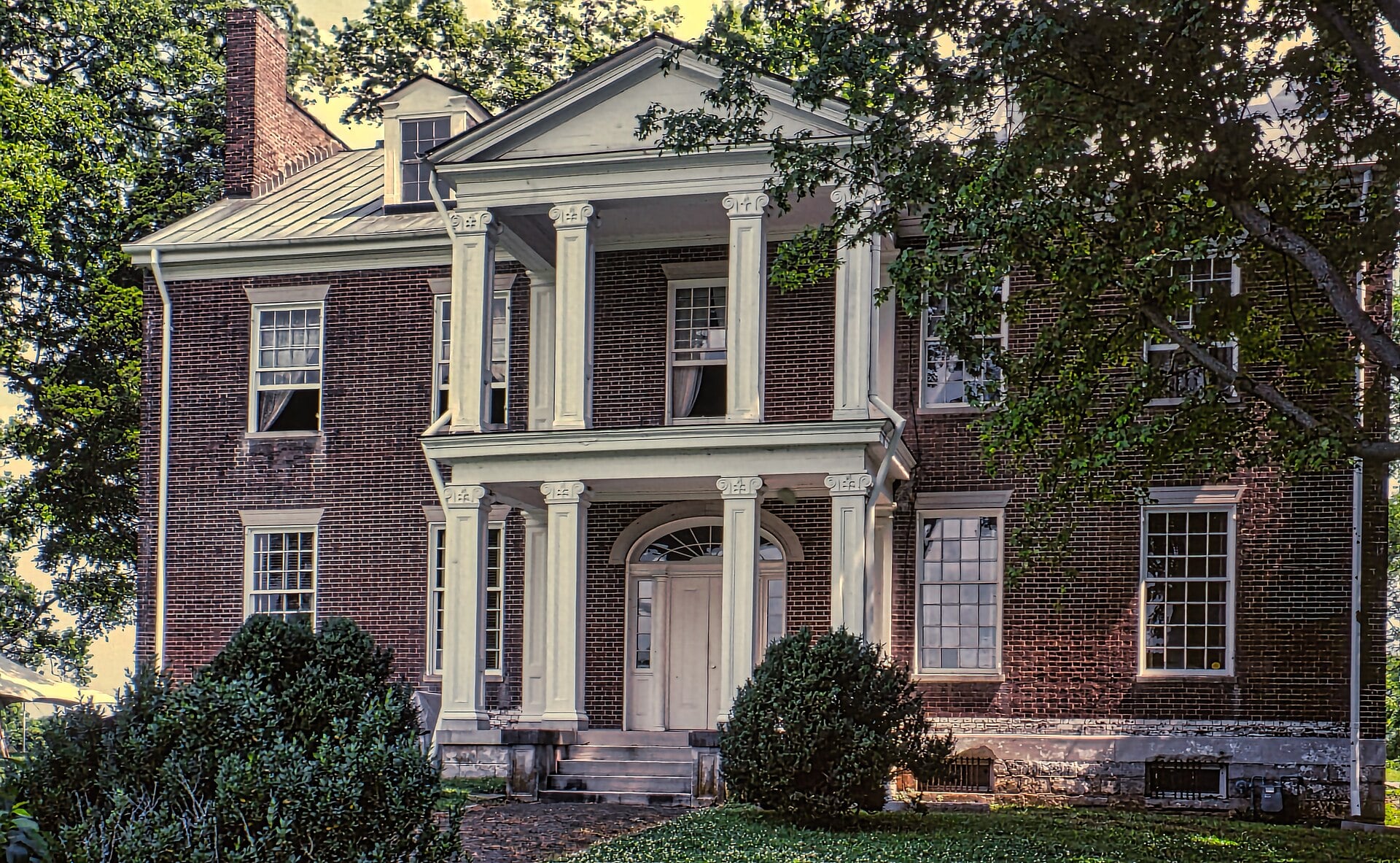
Header photo: Euthman, 1995, CC BY 4.0, via Wikimedia Commons
Quick answer (as of November 2026) Carnton is the 1826 McGavock family house at 1345 Eastern Flank Circle in Franklin, TN, owned and run by the Battle of Franklin Trust. During the Battle of Franklin on November 30, 1864, it was the largest field hospital in the area, and in 1866 John and Carrie McGavock set aside two acres beside their family cemetery for nearly 1,500 Confederate soldiers killed at Franklin. That's the McGavock Confederate Cemetery. Carnton is open Monday to Saturday from 9 a.m. to 5 p.m. and Sunday from 10 a.m. to 5 p.m., with the last guided tour at 4 p.m. The Classic House Tour is $22 for adults and $14 for ages 6 to 15, and parking is free.
Carnton is where you see what the Battle of Franklin left behind: bloodstained floors, the back porch where four Confederate generals' bodies lay the next morning, and nearly 1,500 graves beside the family cemetery. The Trust sells nine different tickets for Carnton, so the planning questions are practical ones: which tour, what it costs, which days it's closed, where to park and how to fit it in with the Lotz House and the Carter House.
What is Carnton in Franklin, TN?
Carnton is a historic house museum in Franklin, Williamson County, owned by the Battle of Franklin Trust, a 501(c)(3) that runs on admissions, gift shop sales, memberships and donations. Randal McGavock built the house in 1826. Per the Trust's history of Carnton, it grew into one of the largest farms in Williamson County, and its visitors included President Andrew Jackson.
Randal's son John inherited the farm and married Carrie Elizabeth Winder in December 1848. They had five children, and three died young. Winder and Hattie survived. The Trust notes that John McGavock was very skeptical of secession and never served in the Confederate Army.
The McGavock family owned Carnton until 1911, when Susie Lee McGavock, Winder's widow, sold it. Carnton was listed on the National Register of Historic Places in 1973, and in 1977 Dr. and Mrs. W. D. Sugg donated the house and ten acres to the Carnton Association, which restored it. The Battle of Franklin Trust owns it today, along with the Carter House in Franklin and Rippa Villa in Spring Hill.
Was Carnton a plantation, and who was enslaved there?
Yes. By 1860, John and Carrie McGavock enslaved 44 people at Carnton and owned roughly 700 acres, per the Battle of Franklin Trust. The Trust calls the site Carnton, and you'll also see the same place listed as Carnton Plantation.
The Trust's Enslaved Project describes the work. Enslaved people drew water from the spring and carried it up the hill, cooked, washed clothes and linens, cut and split wood, built and repaired fences, plowed and planted, sheared sheep and spun the wool, brought in the corn and grain harvest, slaughtered and smoked hogs, pressed cider and wine and stored potatoes for the winter. That labor supported the five members of the McGavock family. In the few hours that were their own, the enslaved community at Carnton built its own culture, music, food and religion.
The Trust names 14 people enslaved at Carnton on its Stories of the Enslaved page. One of them, Mariah McGavock Otey Reddick, was owned by Carrie McGavock, was a prominent presence in the household and became a respected member of the community after the war. The Trust has commissioned a bronze bust of her, installed five life-sized silhouettes of enslaved individuals at Carnton, and plans a memorial at Carnton with stone reflection benches and running water.
Per the Trust, the 44 people enslaved at Carnton in 1860 were among more than 12,000 enslaved in Williamson County and over 275,000 in Tennessee. The 90-minute Slavery & the Enslaved Tour covers this history at 12:30 p.m., Monday to Saturday, for $29.
What happened at Carnton during the Battle of Franklin?
Carnton was the largest field hospital in the area during the Battle of Franklin, and hundreds of wounded and dying Confederate soldiers were treated there, per the Trust. The fighting began at 4 p.m. on November 30, 1864, when the Confederate Army of Tennessee attacked the Federal army entrenched along Franklin's southern edge. The Trust says most of the combat came after dark at close quarters, and the battle lasted barely five hours.
A staff officer wrote that "the wounded, in hundreds, were brought to [the house] during the battle," and all through the night, and that once the house was full the yard was used. On the morning of December 1, 1864, the bodies of four Confederate generals killed in the fighting, Patrick R. Cleburne, Hiram B. Granbury, John Adams and Otho F. Strahl, lay on Carnton's back porch. The floors of the restored house are still stained with the blood of the men treated there.
How many people died in the Battle of Franklin?
The National Park Service estimates 9,933 casualties at Franklin: 7,300 Confederate and 2,633 Union. The Battle of Franklin Trust puts the number at some 9,500 killed, wounded, captured or missing, nearly 7,000 of them Confederate. Both figures count the wounded, captured and missing along with the dead, so fewer men were killed than either total.
The Park Service records Franklin as a Union victory. By the end of the fighting, six Confederate generals were dead or mortally wounded, and four of them lay on Carnton's back porch the next morning. The Trust describes the Confederate frontal assault as larger than Pickett's Charge at Gettysburg.
What is the McGavock Confederate Cemetery?
The McGavock Confederate Cemetery is a two-acre burial ground at Carnton for nearly 1,500 Confederate soldiers killed in the Battle of Franklin. In early 1866, John and Carrie McGavock set the land aside next to their own family cemetery, and they kept up the cemetery until their deaths, per the Trust. Today it's a memorial to those soldiers and the battle.
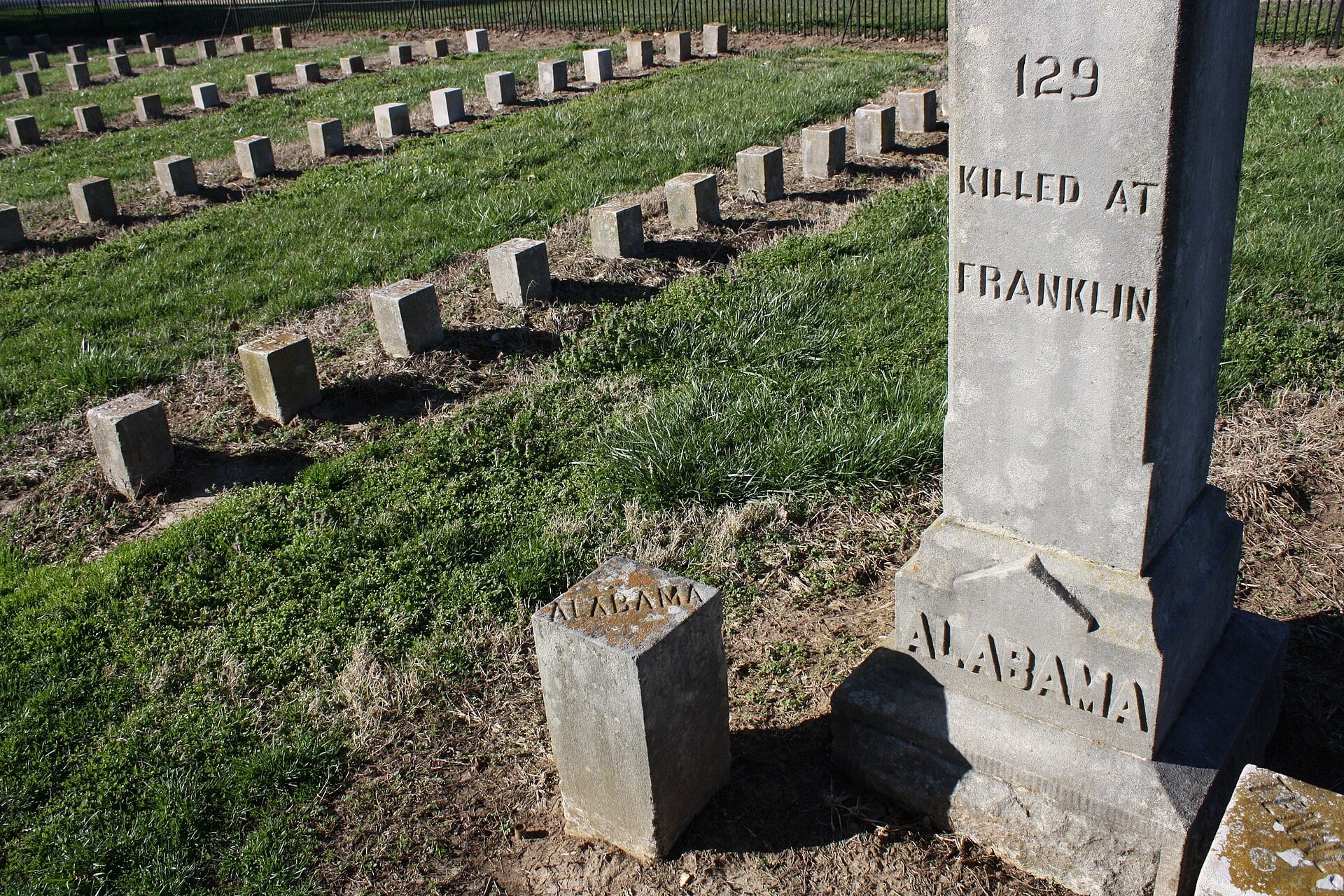
Carnton's grounds open at 9 a.m. (10 a.m. on Sunday) and close at 5 p.m., per the Trust's site policies. The Extended Tour covers both the house and the grounds if you want a guide with you.
What tours does Carnton offer, and how much are tickets?
The Classic House Tour is the standard visit: 60 minutes, $22 for adults and $14 for ages 6 to 15, with tours leaving about every 30 to 40 minutes. You get your tour time when you arrive, and you can buy tickets on site or online. Here's every tour the Trust lists for Carnton, as of November 2026.
| Tour | What it covers | Length | Price (as of November 2026) | When |
|---|---|---|---|---|
| Classic House Tour | Guided tour of the house | 60 minutes | Adults $22, ages 6 to 15 $14 | Walk-in, every 30 to 40 minutes, last tour 4 p.m. |
| Extended Tour | The house and grounds | 90 minutes | $29 | 11 a.m. and 2 p.m. Monday to Saturday, 11 a.m. Sunday |
| Slavery & the Enslaved Tour | Slavery as an institution and the people enslaved at Carnton | 90 minutes | $29 | 12:30 p.m. Monday to Saturday |
| All Men Are Created Equal Tour | The country from its founding to the Civil War and the fight over equality and slavery | 90 minutes | $29 | 9 a.m. Monday to Saturday |
| Behind the Scenes Tour | Parts of the house not on the Classic House Tour | 90 minutes | $29 | 10 a.m. Monday to Friday |
| Carnton Battlefield Tour | Walking tour of the Eastern Flank of the Franklin battlefield | Not posted | $29 | 2 p.m. Monday, Tuesday, Wednesday, Thursday and Saturday |
| Amazing Grace Tour | The Trust's Christian theological perspective on the Civil War | 90 minutes | $29 | 9 a.m. Wednesday, online only |
| Combination ticket | 60-minute guided house tours at the Carter House and Carnton | 60 minutes each | $28 | Online only, any day, through December 31, 2026 |
| Tennessee Campaign Ticket | 60-minute guided tours at Carnton, the Carter House and Rippa Villa | 60 minutes each | $40 | Walk-in, last tour 4 p.m. |
Arrive 15 minutes early for any timed tour. The Trust's tickets page says walk-ins are always welcome, a wait of 30 to 40 minutes can happen, and tickets are nonrefundable. Rippa Villa, the Trust's site in Spring Hill, is $10 for a classic house tour through December 31, 2026. My things to do in Spring Hill guide covers it.
For photos inside the house, the Trust sells a 45-minute slot from 8:30 to 9:15 a.m., Monday to Saturday, for $50. It's limited to three people a day and has to be bought online at least 24 hours ahead.
When is Carnton open?
Carnton is open Monday to Saturday from 9 a.m. to 5 p.m. and Sunday from 10 a.m. to 5 p.m., as of November 2026, and the last guided tour starts at 4 p.m. It closes on New Year's Day, Easter, Thanksgiving, Christmas Eve and Christmas Day. This season, that means Carnton is closed Thursday, November 26, Thursday, December 24, Friday, December 25, and Friday, January 1, 2027.
Carnton's phone number is 615-794-0903. If you're going late in the day, get there well before 4 p.m. so a walk-in wait doesn't push you past the last tour.
Where is Carnton, and where do you park?
Carnton is at 1345 Eastern Flank Circle, Franklin, TN 37064, and parking is free. Per the Trust's directions, from I-65 take exit 65 and head west on Highway 96 (Murfreesboro Road) for 1.1 miles, turn left on Mack Hatcher Parkway for 1.4 miles, turn right at the second light onto Lewisburg Pike (US 431) for 0.9 miles, then turn left onto Eastern Flank Circle and follow it to the Fleming Center. Eastern Flank Circle is one-way, so you'll pass the exit before you reach the entrance.
Carnton has handicap parking and a curbside drop-off spot. The Fleming Center is wheelchair accessible and lends standard wheelchairs free. The first floor of the house is wheelchair accessible, and the tour goes up 22 steps to the second floor, so ask for the companion guide with photos of the upstairs if you'd rather stay on the first floor. Leashed dogs are welcome on the grounds but not inside the buildings.
What's happening at Carnton in November and December 2026?
On Monday, November 30, 2026, the battle's 162nd anniversary, the Trust runs 60-minute night tours at Carnton and the Carter House at 7 and 8 p.m., $30 a person, focused on what happened at each house that evening. Groups are capped at 20, tickets have to be bought online ahead of time, and children under 6 aren't permitted. The Trust asks you not to book both houses the same night, since there isn't time to get from one to the other.
| Date | Event | Where |
|---|---|---|
| Sunday, November 8 | Franklin Civil War Round Table, 3 p.m., Chris Mackowski on John Adams and the American Revolution | Carnton's Fleming Center |
| Thursday, November 26 | Closed for Thanksgiving | Carnton and the Carter House |
| Sunday, November 29 | Anniversary night tours, 7 and 8 p.m., $30 | Rippa Villa, Spring Hill |
| Monday, November 30 | Anniversary night tours, 7 and 8 p.m., $30 | Carnton and the Carter House |
| Monday, November 30 | Battle anniversary luminaries | Lotz House |
| Saturday and Sunday, December 12 and 13 | Dickens of a Christmas | Main Street, downtown Franklin |
| Sunday, December 13 | Franklin Civil War Round Table, 3 p.m., Joseph Ricci on Federal Command at Franklin | Carnton's Fleming Center |
| Thursday and Friday, December 24 and 25 | Closed for Christmas Eve and Christmas | Carnton and the Carter House |
| Thursday, December 31 | Last day for the $28 combination ticket and the $10 Rippa Villa tour | Online and Rippa Villa |
The Round Table meets the second Sunday of every month at Carnton's Fleming Center, and the Trust says it moves to the Harper Center at the Carter House after the New Year. Call 615-794-0903 to check whether there's space before you plan around it. The rest of the holiday season downtown is on my Christmas in Franklin page.
How do you see Carnton, the Lotz House and the Carter House in one day?
Start at the Lotz House, walk across Columbia Avenue to the Carter House, have lunch downtown, then drive about 2.3 miles (about 10 minutes without traffic) to Carnton for the afternoon. If you can do it Monday to Thursday or Saturday, book the 2 p.m. Carnton Battlefield Tour, then catch a Classic House Tour before the 4 p.m. cutoff. The $28 combination ticket covers house tours at both Trust sites in Franklin. The Lotz House sells its own tickets, and my Lotz House guide has its tours and prices.
| Stop | Address | Hours (as of November 2026) | Tickets |
|---|---|---|---|
| Lotz House | 1111 Columbia Avenue | Monday to Saturday 9 a.m. to 5 p.m., Sunday 11 a.m. to 4 p.m. | Sold by the Lotz House |
| Carter House (built 1830) | 125 West Fowlkes Street, across Columbia Avenue | Monday to Saturday 9 a.m. to 5 p.m., Sunday 10 a.m. to 5 p.m., last tour 4 p.m. | Classic tour $22 adults, $14 ages 6 to 15; $28 combination online |
| Main Street | Downtown, a few blocks north | Varies by shop | |
| Carnton | 1345 Eastern Flank Circle, about 2.3 miles from the Carter House | Same as the Carter House | Classic tour $22 adults, $14 ages 6 to 15; $28 combination online |
On a Sunday, flip the order: the Trust's sites open at 10 a.m. and the Lotz House at 11 a.m. After your Carnton tour, the city's free Eastern Flank Battlefield Park is right next door at 1368 Eastern Flank Circle, 110 acres with walking and interpreted trails, open dawn to dark. The rest of what's free in town is in my things to do in Franklin guide.
Carnton is about 10 miles and 20 minutes up the road from my neighborhood, Canterbury in Thompson's Station. If you're touring Franklin's history because you're thinking about moving here, DM me, text or call 615-392-1186 and tell me what you want close to the house. I'll help you sort out which parts of town fit.
Can you buy a home near Carnton?
Homes come up for sale all over Franklin, and the older ones near downtown carry an extra step worth knowing about before you write an offer. Carnton, the Carter House and the Lotz House are local landmarks inside Franklin's Historic Preservation Overlay, the same zoning overlay that covers the city's seven local historic districts. Inside the overlay, new construction, additions and alterations go through design review under the Franklin Historic District Design Guidelines.
My downtown Franklin and historic homes guide walks through the overlay and shows what's listed now. For the rest of the city, start with my Franklin guide. Franklin has exactly what you'd want out of a small city, with the community events and a small-town feel that's still there.
If Franklin's on your list, DM me, text or call 615-392-1186.
Frequently asked questions
Where is Carnton?
Carnton is at 1345 Eastern Flank Circle, Franklin, TN 37064, in Williamson County, next to the city's Eastern Flank Battlefield Park. Parking is free, and the phone number is 615-794-0903.
Who owns Carnton Plantation?
The Battle of Franklin Trust owns Carnton. The McGavock family sold it in 1911, and in 1977 Dr. and Mrs. W. D. Sugg donated the house and ten acres to the Carnton Association, which restored it.
How much are Carnton tickets?
The Classic House Tour is $22 for adults and $14 for ages 6 to 15, as of November 2026. The 90-minute specialty tours are $29, the online-only combination ticket for the Carter House and Carnton is $28 through December 31, 2026, and the Tennessee Campaign Ticket for all three Trust sites is $40. Tickets are nonrefundable.
How many Confederate generals died at Franklin?
Six Confederate generals were dead or mortally wounded by the end of the Battle of Franklin, per the National Park Service. On the morning of December 1, 1864, the bodies of four of them, Patrick R. Cleburne, Hiram B. Granbury, John Adams and Otho F. Strahl, lay on Carnton's back porch.
Can I take a Civil War tour in Franklin, TN?
Yes. The Battle of Franklin Trust runs the $29 Carnton Battlefield Tour, a walking tour of the Eastern Flank of the battlefield, at 2 p.m. Monday, Tuesday, Wednesday, Thursday and Saturday. The Carter House runs its own 90-minute, $29 Battlefield Tour at 11 a.m. Monday through Thursday and at 11 a.m. and 2 p.m. Friday and Saturday. The Trust also runs house tours at Carnton and the Carter House seven days a week.
Does Carnton do ghost tours?
No. The Battle of Franklin Trust says its programming does not include weddings, concerts, tea parties or ghost tours, and its early-morning photography slots aren't for paranormal investigation. The documented history is the field hospital, the bloodstained floors and the McGavock Confederate Cemetery.
Check out this article next