


Quick answer (as of November 2026) Tennessee has 95 counties. State law, Tennessee Code §§ 4-1-201 to 4-1-204, splits them into three grand divisions: 33 counties in East Tennessee, 41 in Middle Tennessee and 21 in West Tennessee. Middle Tennessee includes Davidson County, home of Nashville, the state capital, along with Williamson, Maury, Rutherford, Sumner, Wilson and Montgomery counties, and all 41 of its counties are on Central time. The federal Nashville metro area is smaller: 14 counties, under OMB Bulletin No. 23-01.
You're scrolling homes "near Nashville," and every few listings the county changes. The county matters more than the town on the mailing address. It sets your property tax rate, and its Assessor of Property is the office that puts a value on your home.
I live in Canterbury in Thompson's Station, in Williamson County, and I made the move here from California myself. Below is the whole state on one map, then the 41 Middle Tennessee counties with their county seats, the counties in the Nashville metro, and the county each of my towns sits in.
How many counties are in Tennessee?
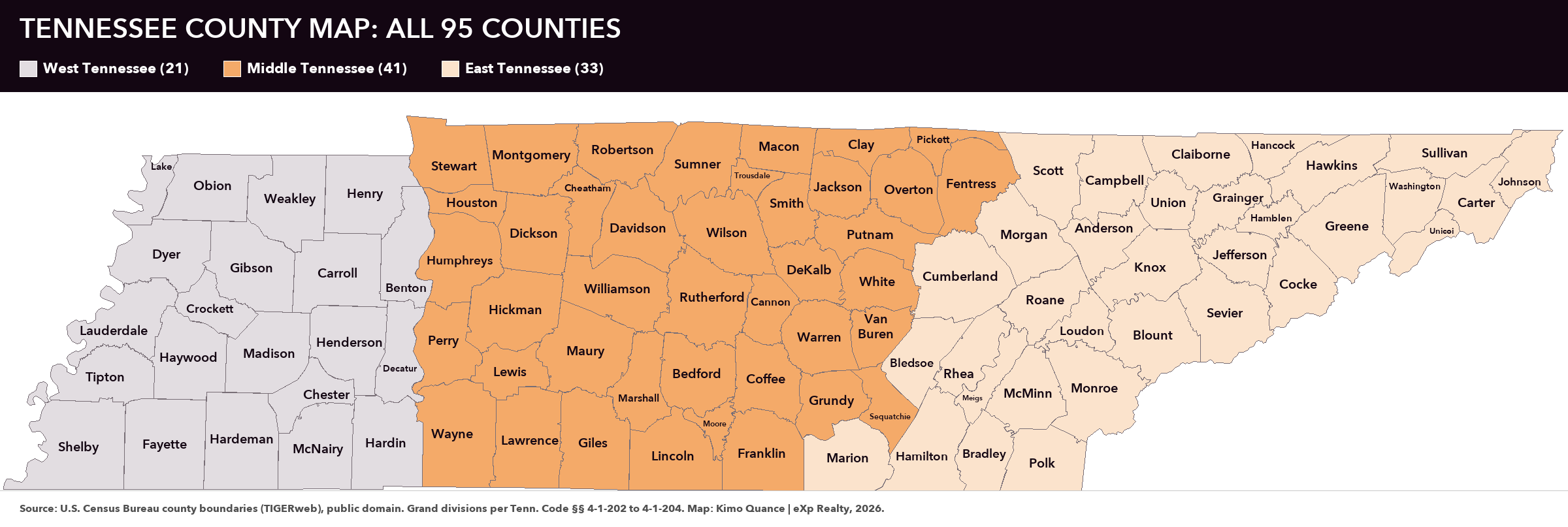
Tennessee has 95 counties. State law assigns each one to East, Middle or West Tennessee, and the three county lists in Tennessee Code §§ 4-1-202 to 4-1-204 add up to 95: 33, 41 and 21.
The Tennessee Department of Transportation's County Outline Map counts the same 95 and numbers them alphabetically. TDOT also groups them into four regions of its own, with offices in Knoxville, Chattanooga, Nashville and Jackson. Those are road regions, and they don't line up with the three divisions in state law.
What are the three grand divisions of Tennessee?
The three grand divisions of Tennessee are East Tennessee, Middle Tennessee and West Tennessee. Tennessee Code § 4-1-201 says the state has three, and the next three sections name every county in each one. When people talk about the parts of Tennessee, these are the three they mean.
| Grand division | Counties | Tennessee Code | Cities you'll know (county) |
|---|---|---|---|
| East Tennessee | 33 | § 4-1-202 | Knoxville (Knox), Chattanooga (Hamilton) |
| Middle Tennessee | 41 | § 4-1-203 | Nashville (Davidson), Murfreesboro (Rutherford), Clarksville (Montgomery) |
| West Tennessee | 21 | § 4-1-204 | Memphis (Shelby), Jackson (Madison) |
The divisions still matter in state government. Article VI, Section 2 of the Tennessee Constitution allows no more than two of the Tennessee Supreme Court's five justices to live in any one grand division, and it holds the court in Knoxville, Nashville and Jackson, one city in each.
East Tennessee's 33 counties are Anderson, Bledsoe, Blount, Bradley, Campbell, Carter, Claiborne, Cocke, Cumberland, Grainger, Greene, Hamblen, Hamilton, Hancock, Hawkins, Jefferson, Johnson, Knox, Loudon, Marion, McMinn, Meigs, Monroe, Morgan, Polk, Rhea, Roane, Scott, Sevier, Sullivan, Unicoi, Union and Washington.
West Tennessee's 21 counties are Benton, Carroll, Chester, Crockett, Decatur, Dyer, Fayette, Gibson, Hardeman, Hardin, Haywood, Henderson, Henry, Lake, Lauderdale, Madison, McNairy, Obion, Shelby, Tipton and Weakley.
What are the parts of Tennessee, and how are they different?
The parts of Tennessee are East, Middle and West Tennessee, and the land changes as you cross them. East Tennessee is mountains and long valleys, Middle Tennessee is the Highland Rim wrapped around the Nashville Basin, and West Tennessee is the flat Gulf Coastal Plain running to the Mississippi River. All of Middle and West Tennessee is on Central time, and most of East Tennessee is on Eastern.
| Part of Tennessee | The land, east to west | Cities you'll know (county) | Time zone | Supreme Court sits in |
|---|---|---|---|---|
| East Tennessee (33 counties) | The Unaka (Great Smoky) Mountains, the Valley and Ridge, and the Cumberland Plateau, which it shares with Middle Tennessee | Knoxville (Knox), Chattanooga (Hamilton) | Eastern, except Cumberland, Bledsoe and Marion counties, which are on Central | Knoxville |
| Middle Tennessee (41 counties) | The Eastern Highland Rim, the Central (Nashville) Basin and the Western Highland Rim | Nashville (Davidson), Murfreesboro (Rutherford), Clarksville (Montgomery), Franklin (Williamson), Columbia (Maury) | Central | Nashville |
| West Tennessee (21 counties) | The Tennessee River's Western Valley, the Plateau Slope of West Tennessee and the Mississippi River floodplain | Memphis (Shelby), Jackson (Madison) | Central | Jackson |
Land regions: Tennessee Historical Society, Tennessee Encyclopedia, "Geologic Zones". Time zones: 49 CFR 71.5. Court cities: Tennessee Constitution, Article VI, Section 2. As of November 2026.
East Tennessee
East Tennessee is the mountain end of the state. Kuwohi, the peak long called Clingmans Dome, rises 6,643 feet in Great Smoky Mountains National Park and is the highest point in Tennessee, per the National Park Service. The Kuwohi name was restored in September 2024. The Tennessee River starts in Knoxville, where the Holston and French Broad rivers meet, and runs 652 river miles to the Ohio River, per the U.S. Geological Survey.
Middle Tennessee
Middle Tennessee is built around a basin. The Central Basin, also called the Nashville Basin, sits below the Highland Rim that surrounds it, and the Cumberland and Elk river valleys cut the Rim into eastern and western halves. The Tennessee Secretary of State notes that limestone, the state rock, is especially abundant in the middle of the state, and that the Tennessee coneflower, a state wildflower, thrives only in Middle Tennessee's limestone and cedar glades.
Franklin, Thompson's Station, Spring Hill and College Grove are all Middle Tennessee, in Williamson County and, for part of Spring Hill, Maury County.
West Tennessee
West Tennessee is the flattest part of the state. Apart from the Western Valley along the Tennessee River, it's geologically part of the Gulf Coastal Plain, with the Mississippi River floodplain along its western edge, per the Tennessee Encyclopedia. Memphis, in Shelby County, sits on the Mississippi.
What do the three stars on the Tennessee flag mean?
The three stars on the Tennessee flag stand for East, Middle and West Tennessee. The flag's designer, LeRoy Reeves, wrote that the white stars represent "the three grand divisions of the state," and the General Assembly adopted his design on April 17, 1905, per the Tennessee Secretary of State.
How many states border Tennessee?
Tennessee borders eight states: Alabama, Arkansas, Georgia, Kentucky, Mississippi, Missouri, North Carolina and Virginia, per the State of Tennessee's County and State Facts. Arkansas and Missouri sit across the Mississippi River from West Tennessee.
If you're moving here, the part of Tennessee you choose sets your time zone and your drive to Nashville. For home prices and drive times by region, see my guide to moving to Tennessee, and for how I work with buyers coming from another state, see my relocation page.
What is Middle Tennessee?
Middle Tennessee is the 41-county middle division of the state, defined by name in Tennessee Code § 4-1-203. Its counties run from the Kentucky state line to the Alabama state line, and it includes Nashville, which § 4-1-205 makes the seat of state government, plus Murfreesboro, Clarksville, Franklin, Columbia and Cookeville.
Sequatchie and Grundy counties are Middle Tennessee by law, while Bledsoe and Marion counties next door are East Tennessee.
Which counties are in Middle Tennessee?
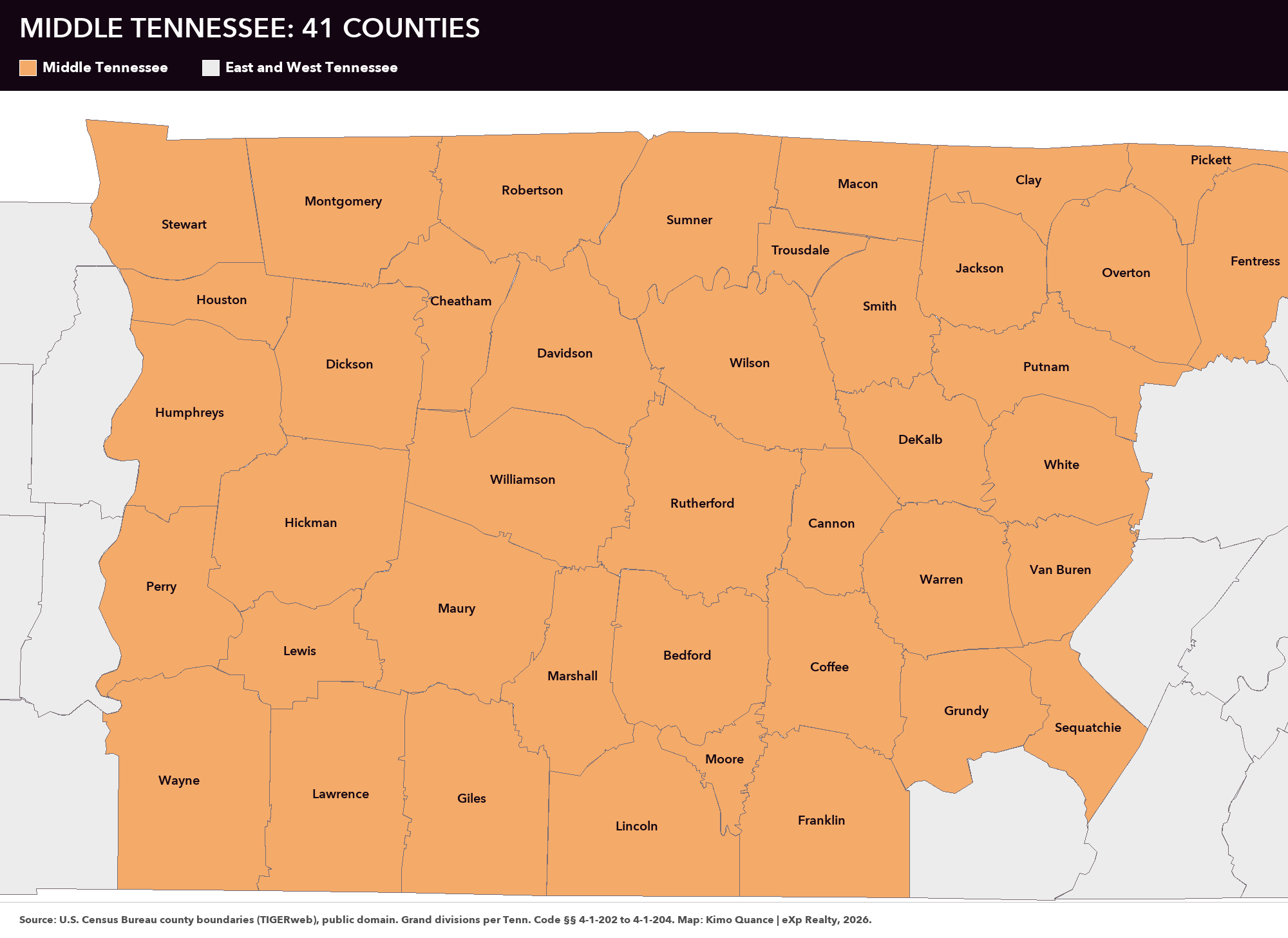
The 41 Middle Tennessee counties are Bedford, Cannon, Cheatham, Clay, Coffee, Davidson, DeKalb, Dickson, Fentress, Franklin, Giles, Grundy, Hickman, Houston, Humphreys, Jackson, Lawrence, Lewis, Lincoln, Macon, Marshall, Maury, Montgomery, Moore, Overton, Perry, Pickett, Putnam, Robertson, Rutherford, Sequatchie, Smith, Stewart, Sumner, Trousdale, Van Buren, Warren, Wayne, White, Williamson and Wilson. Here they are with each county seat, the year the county was created and whether it's in the Nashville metro.
| County | County seat | Year created | Nashville metro? |
|---|---|---|---|
| Bedford County | Shelbyville | 1807 | Combined area only |
| Cannon County | Woodbury | 1836 | Nashville metro |
| Cheatham County | Ashland City | 1853 | Nashville metro |
| Clay County | Celina | 1870 | No |
| Coffee County | Manchester | 1836 | Combined area only |
| Davidson County | Nashville | 1783 | Nashville metro |
| DeKalb County | Smithville | 1838 | No |
| Dickson County | Charlotte | 1803 | Nashville metro |
| Fentress County | Jamestown | 1823 | No |
| Franklin County | Winchester | 1807 | Combined area only |
| Giles County | Pulaski | 1809 | No |
| Grundy County | Altamont | 1844 | No |
| Hickman County | Centerville | 1807 | Nashville metro |
| Houston County | Erin | 1871 | No |
| Humphreys County | Waverly | 1809 | No |
| Jackson County | Gainesboro | 1801 | No |
| Lawrence County | Lawrenceburg | 1817 | Combined area only |
| Lewis County | Hohenwald | 1843 | No |
| Lincoln County | Fayetteville | 1809 | No |
| Macon County | Lafayette | 1842 | Nashville metro |
| Marshall County | Lewisburg | 1836 | Combined area only |
| Maury County | Columbia | 1807 | Nashville metro |
| Montgomery County | Clarksville | 1796 | No (Clarksville metro) |
| Moore County | Lynchburg | 1871 | Combined area only |
| Overton County | Livingston | 1806 | No |
| Perry County | Linden | 1819 | No |
| Pickett County | Byrdstown | 1879 | No |
| Putnam County | Cookeville | 1842 | No |
| Robertson County | Springfield | 1796 | Nashville metro |
| Rutherford County | Murfreesboro | 1803 | Nashville metro |
| Sequatchie County | Dunlap | 1857 | No |
| Smith County | Carthage | 1799 | Nashville metro |
| Stewart County | Dover | 1803 | No (Clarksville metro) |
| Sumner County | Gallatin | 1786 | Nashville metro |
| Trousdale County | Hartsville | 1870 | Nashville metro |
| Van Buren County | Spencer | 1840 | No |
| Warren County | McMinnville | 1807 | No |
| Wayne County | Waynesboro | 1817 | No |
| White County | Sparta | 1806 | No |
| Williamson County | Franklin | 1799 | Nashville metro |
| Wilson County | Lebanon | 1799 | Nashville metro |
County seats and years: University of Tennessee County Technical Assistance Service directory, as of November 2026. Metro column: OMB Bulletin No. 23-01. "Combined area only" means the county is in the wider Nashville combined statistical area but not the 14-county metro.
Which counties are in the Nashville metro area?
The Nashville metro area is 14 counties: Cannon, Cheatham, Davidson, Dickson, Hickman, Macon, Maury, Robertson, Rutherford, Smith, Sumner, Trousdale, Williamson and Wilson. That's the federal definition, the Nashville-Davidson--Murfreesboro--Franklin, TN Metropolitan Statistical Area in OMB Bulletin No. 23-01 (July 21, 2023), with Nashville, Murfreesboro, Franklin and Smyrna as its principal cities.
The wider Nashville-Davidson--Murfreesboro combined statistical area brings in six more Middle Tennessee counties through their own smaller areas: Bedford (Shelbyville), Coffee and Moore (Tullahoma-Manchester), Franklin (Winchester), Lawrence (Lawrenceburg) and Marshall (Lewisburg). That makes 20 counties.
Montgomery County is Middle Tennessee but outside the Nashville metro. OMB puts it and Stewart County in the Clarksville, TN-KY metro area, along with two Kentucky counties.
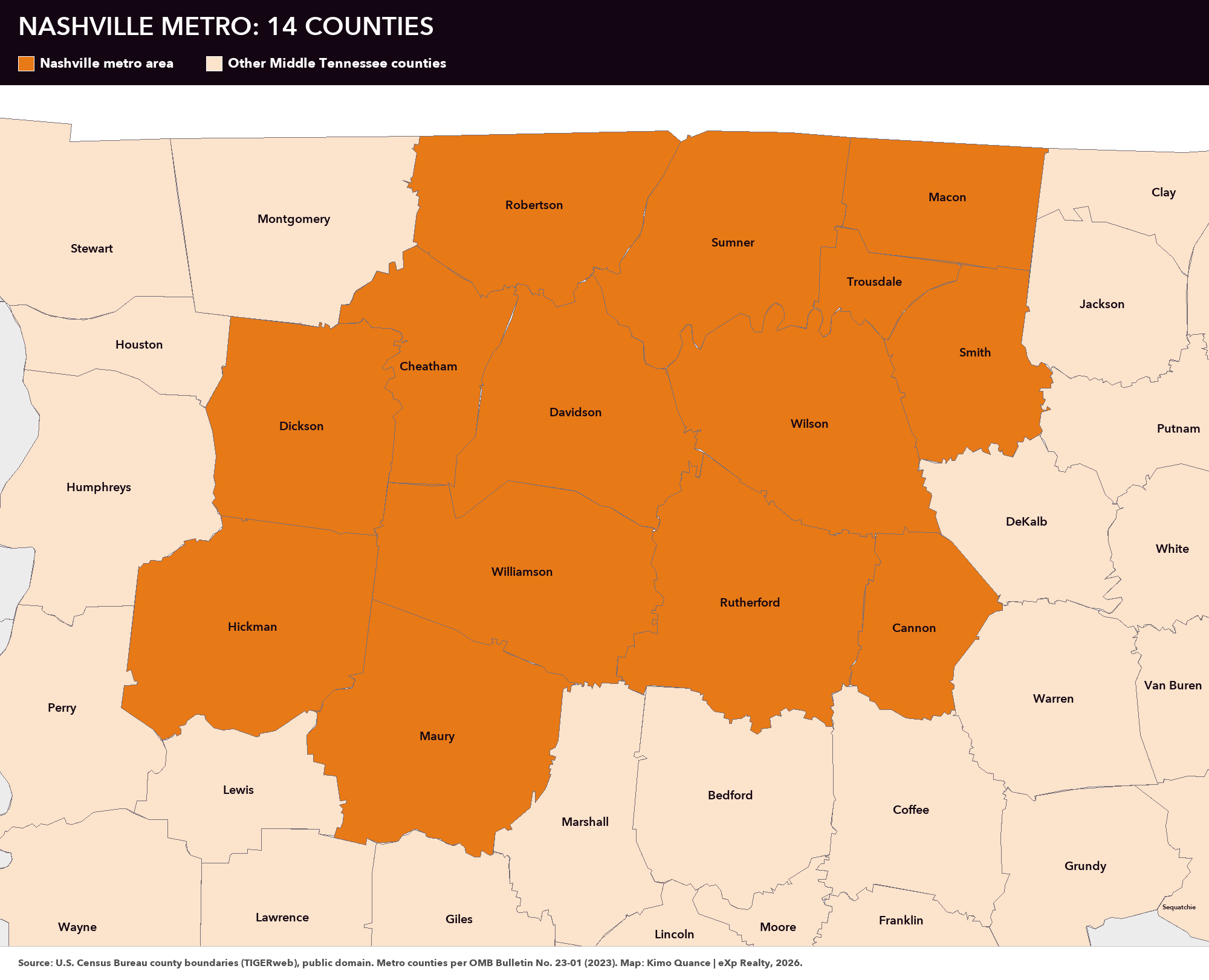
Listings and ads use "Middle Tennessee" and "the Nashville area" loosely. When a number matters to you, like a median price, ask which of these definitions it's built on.
What time zone is Middle Tennessee in?
All 41 Middle Tennessee counties are on Central time. The federal time zone rule, 49 CFR 71.5, runs the Eastern line along the edges of Scott, Morgan, Roane, Rhea and Hamilton counties in East Tennessee, and everything west of that line is Central.
That line doesn't match the grand divisions exactly. Cumberland, Bledsoe and Marion counties are East Tennessee by law and still on Central time, while Chattanooga, in Hamilton County, is on Eastern.
Which county are Franklin, Thompson's Station, Spring Hill, College Grove and Nashville in?
Franklin, Thompson's Station and College Grove are in Williamson County, Spring Hill sits in both Williamson and Maury counties, and Nashville is in Davidson County. All five are in Middle Tennessee and inside the 14-county Nashville metro. To see what's for sale in each, start with Franklin TN homes for sale, Thompson's Station homes for sale, Spring Hill TN homes for sale, College Grove homes for sale and Nashville homes for sale.
| Town | County | What to know |
|---|---|---|
| Franklin | Williamson | Williamson County's seat and one of the Nashville metro's principal cities |
| Thompson's Station | Williamson | An incorporated town, and where I live, in Canterbury |
| Spring Hill | Williamson and Maury | The city sits in both counties, so check the county on every address |
| College Grove | Williamson | An unincorporated community, so there's no city government |
| Nashville | Davidson | The state capital; Nashville and Davidson County share one metro government |
Spring Hill is the one that trips people up. The city sits in two counties, so two homes a few minutes apart can have different county tax rates and a different assessor. Here's how to tell which county a Spring Hill address is in, and how Spring Hill property taxes compare on each side.
If you're weighing towns in more than one county, send me the towns or the addresses, and I'll tell you the county, whether it's inside city limits and what that changes. DM, text or call 615-392-1186.
How do I find out which county a Tennessee address is in?
Run the address through the U.S. Census Bureau geocoder. It returns the county, and under "Incorporated Places" it names the city if the home is inside its limits. Don't go by the ZIP code. A mailing ZIP can cross a county line or a city limit, and Spring Hill's 37174 covers parts of both Williamson and Maury counties.
- Open the Census geocoder and enter the street, city, state and ZIP.
- Read the County line to get the county.
- Read "Incorporated Places." If no city shows, the home is outside city limits.
- Look up the parcel with that county's Assessor of Property, the office that values the home for property tax.
If you're buying from another state, I'll record a video walkthrough of any home you're serious about and send you an unlisted YouTube link you can rewatch as often as you need. Here's how to buy a house in Tennessee from another state, what to weigh when moving to Tennessee, and how I work with relocation buyers. If you already know where you'll work, start with where to live in Nashville.
Tell me which part of Middle Tennessee you're looking at and what you want to spend, and I'll send back the towns that fit, with the county on every address. In Maury County, start with Columbia TN homes for sale. DM, text or call 615-392-1186, or use the form below.
Frequently Asked Questions
How many counties are in Tennessee?
Tennessee has 95 counties: 33 in East Tennessee, 41 in Middle Tennessee and 21 in West Tennessee, as listed in Tennessee Code §§ 4-1-202 to 4-1-204.
How many counties are in Middle Tennessee?
Middle Tennessee has 41 counties under Tennessee Code § 4-1-203. Fourteen of them make up the federal Nashville metro area.
What are the three parts of Tennessee?
The three parts of Tennessee are East, Middle and West Tennessee, the grand divisions set by Tennessee Code § 4-1-201. East Tennessee has 33 counties, Middle Tennessee 41 and West Tennessee 21.
What is Middle Tennessee?
Middle Tennessee is the 41-county middle division of the state, defined by name in Tennessee Code § 4-1-203. It includes Nashville, Murfreesboro, Clarksville, Franklin and Columbia, and all 41 of its counties are on Central time.
Is Chattanooga in Middle Tennessee?
No. Chattanooga is in Hamilton County, which state law places in East Tennessee, and it's on Eastern time.
Is Clarksville in Middle Tennessee?
Yes. Clarksville is in Montgomery County, which is Middle Tennessee by law. For federal statistics it's in the Clarksville, TN-KY metro area, separate from Nashville's.
What county is Spring Hill, TN in?
Spring Hill is in both Williamson County and Maury County, so check the county on the exact address before you compare property taxes.
Check out this article next