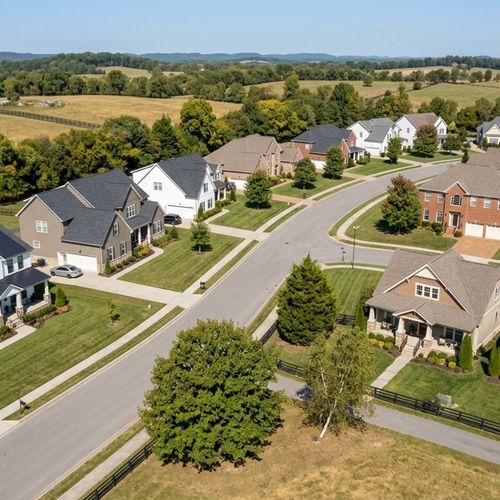


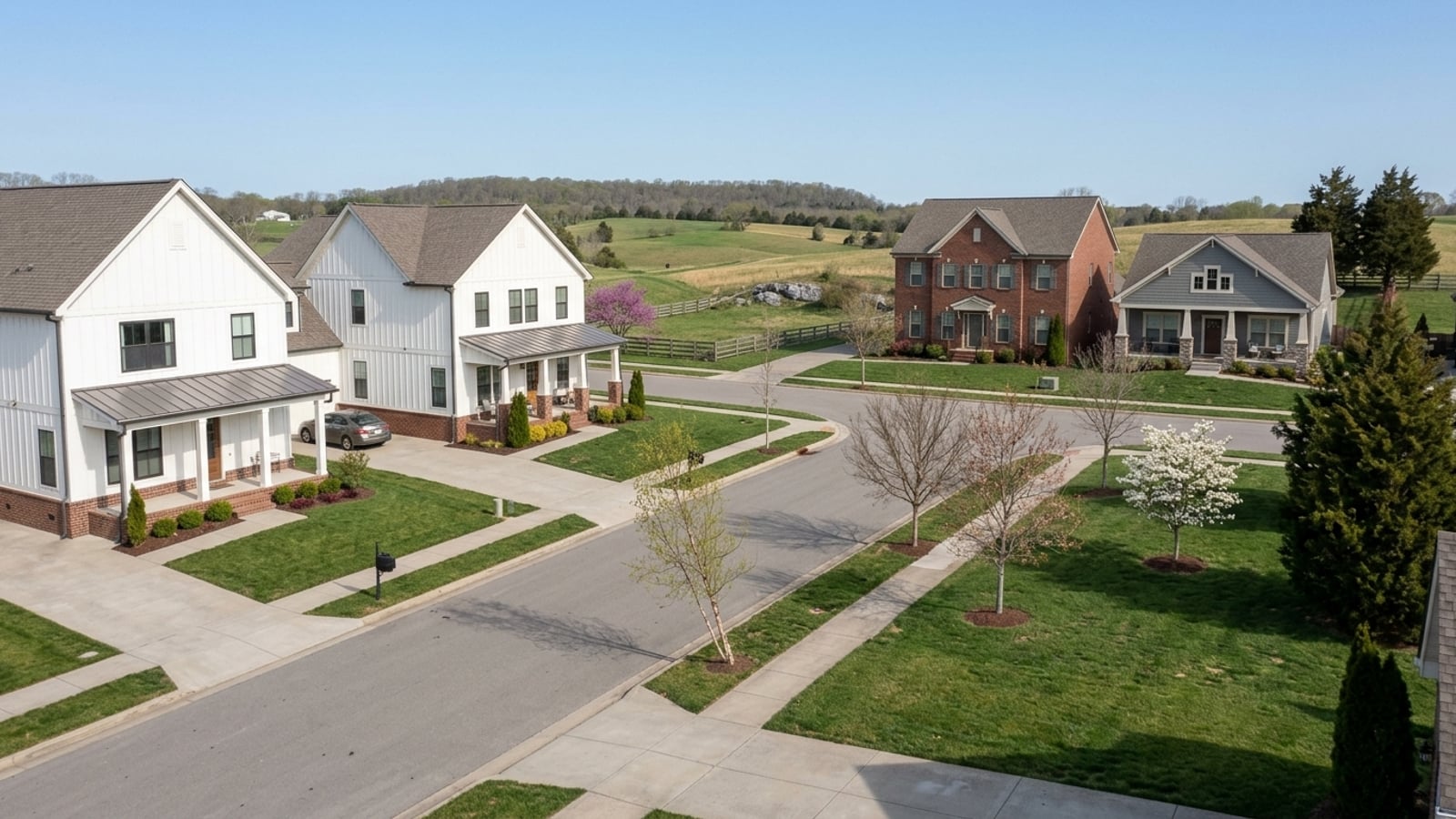
Thompson's Station sits south of Franklin as a growing Williamson County suburb. Over the last few decades, former farmland has turned into residential neighborhoods, bringing thousands of new residents to the area.
Thompson's Station grew from 2,194 residents in 2010 to 7,485 in 2020. When a town expands rapidly, the types of homes builders construct dictate where buyers have bargaining power and where they face competition.
Key takeaway
Thompson's Station counted 7,485 residents in the 2020 Census, and the latest Census Bureau estimates show it continuing to grow. That growth arrived mostly as new subdivisions, so detached houses are not scarce right now. Single-family prices are down from a year ago and supply runs above six months, which gives house buyers room to negotiate. If you would rather pay less per square foot, townhouses are the alternative, though they are the tighter part of the market.
Who this guide is for
You are considering buying or moving in Thompson's Station and want to know how big the town is, how fast it is growing, and whether that growth means you should negotiate hard or move quickly on the home you want.
What is the population of Thompson's Station, TN?
Thompson's Station's population has grown fast, but the subdivisions built to house it have kept detached homes in ample supply. The single-family median sale price fell 4.7% year over year to around $905,389, and the segment currently carries 6.4 months of supply.
The 2020 Census recorded 7,485 residents for Thompson's Station town in Williamson County. Between decennial counts, the Census Bureau publishes annual subcounty estimates. Check the Census Bureau website for the most recent estimate vintage and release schedule to see how much the town has grown since 2020.
One thing to watch: data sites often mix estimate years, and the 37179 ZIP code covers more ground than the town limits. Mailing addresses don't perfectly align with municipal borders. Use the Williamson County property assessor or GIS to confirm whether a specific parcel is inside town limits, because that determines which local government's rules and services apply.
Thompson's Station population growth since 1990
The town incorporated in 1990, so there's no official 1990 decennial census count for the municipality from a primary government source. By the 2000 Census, the town had 1,283 residents. That climbed to 2,194 by the 2010 Census.
From 2,194 in 2010 to 7,485 in 2020, the population more than tripled in ten years. Most of these new residents moved into newly built homes as the area transitioned from agricultural use to residential development. Because builders focused on detached housing, the supply of single-family homes largely kept pace with the influx of people. You can read more about this farm-town-to-suburb transition on our town history page.
Population density and land area
The town covers 20.35 square miles of land area as of the 2020 Census, up from 18.76 square miles in 2010. Divide the 7,485 residents by those 20.35 square miles and you get a population density of about 368 people per square mile.
The household count tells a similar story. In 2000 there were 447 households recorded in the town; by 2020 that number had grown to 1,911.
On the ground, this density looks like specific subdivisions with amenity centers surrounded by larger rural parcels and open farmland. You can explore these housing styles on our types of homes page. For any rural or large-lot parcel, confirm sewer versus septic service with the seller and the utility before you get too far into the process.
How Thompson's Station's population compares with nearby towns
Franklin, the Williamson County seat just to the north, is much larger, with a 2020 Census population of 83,454 and a 2025 estimate of 90,226. Spring Hill borders Thompson's Station to the south and recorded 50,005 residents in 2020, with a 2025 estimate of 61,336. Williamson County as a whole had a 2020 population of 247,726 and a 2025 estimate of 272,061.
Thompson's Station is the smaller place between two much larger neighbors, which means most major shopping, jobs, and services sit just across the town's borders. You can compare home prices in our Thompson's Station vs Franklin guide, or see how the markets stack up in our Thompson's Station vs Spring Hill guide.
Thompson's Station housing market and population growth
The population boom brought a wave of residential construction, but that growth was absorbed almost entirely by new detached homes. The practical result is that buyer advantage currently sits with single-family houses, while the tightness is concentrated in the small attached housing segment.
Single-family supply sits at 6.4 months, giving you room to negotiate, while townhouse supply is just 4 months, so you need to move faster there. You can track ongoing monthly trends on our housing market page.
Single-family homes
At the current sales pace, it would take about 6.4 months to sell every single-family home listed in Thompson's Station. Sellers who priced high are sitting, and buyers can ask for price cuts, rate buydowns, or closing help. Check each listing's history for price reductions before making an offer.
That said, bargaining power is uneven. More than a quarter (28.1%) of single-family homes still sold above list recently, so a fresh, well-priced house in a popular section can draw competing offers. The room to negotiate sits mostly with listings that have lingered.
Townhouses
Townhouses are the cheapest way to buy square footage in Thompson's Station, at $273 per square foot against $317 for detached houses (based on 12 townhouse sales). On a typical floor plan, that gap saves thousands of dollars for the same interior space. With only 4 months of supply, expect less room to negotiate here than on houses.
What you give up is certainty on carrying costs. HOA dues add to the monthly cost and can erase part of the per-square-foot advantage, so ask the HOA for current dues, what they cover, and any planned special assessments before comparing against a house. The recent year-over-year jump in the townhouse median also rests on just 12 sales, so it may reflect which new units happened to close rather than a lasting trend.
Condos
The median Thompson's Station condo took 311 days to sell, based on just 10 sales. Condos sold close to asking price despite those long waits, and they carry the highest price per square foot on this page at $324. A long median time on market alongside near-asking prices can happen when listings are posted well before construction finishes, so ask whether a condo was listed before the building was done.
You pay the most per square foot of any home type here, and with only 10 sales the figures can swing sharply. Check a condo's full listing history. If you plan to use an FHA loan, confirm the complex's FHA approval status on HUD's condo approval lookup before you get attached to a unit.
Thompson's Station housing market at a glance
These figures come from Redfin data for the 90 days ending 2026-09-30.
- All homes, 90 days ending 2026-09-30 (80 sales): median sale price $833,246, up 1.7% year over year; median $304 per square foot
- All homes, 90 days ending 2026-09-30: median 65 days on market; 99% sale-to-list ratio; 24.1% sold above list price
- All homes, 90 days ending 2026-09-30: 151 homes for sale; 5.8 months of supply
- Single-family homes, 90 days ending 2026-09-30 (58 sales): median sale price $905,389, down 4.7% year over year; median $317 per square foot
- Single-family homes, 90 days ending 2026-09-30: median 60 days on market; 99% sale-to-list ratio; 28.1% sold above list; 121 for sale; 6.4 months of supply
- Townhouses, 90 days ending 2026-09-30 (based on 12 sales, so treat as a rough guide): median sale price $633,758, up 21.2% year over year; median $273 per square foot; median 66 days on market
- Townhouses, 90 days ending 2026-09-30 (12 sales): 98.5% sale-to-list ratio; 8.3% sold above list; 16 for sale; 4 months of supply
- Condos, 90 days ending 2026-09-30 (based on 10 sales, so treat as a rough guide): median sale price $412,408, unchanged year over year; median $324 per square foot; median 311 days on market
- Condos, 90 days ending 2026-09-30 (10 sales): 100.3% sale-to-list ratio; 20% sold above list; 15 for sale; 4.4 months of supply
How Thompson's Station is planning for growth
The town uses a long-range plan to manage its expanding population and coordinate infrastructure. Local constraints and utility projects will shape future housing supply, which determines whether today's buyer advantage lasts. Ask the Thompson's Station planning department what developments are approved near the property you want to buy.
Wastewater capacity and new development
Sewer capacity decides where and how fast new subdivisions can be approved. The town operates two facilities: the Heritage Commons WWTF is rated at 30,000 gallons per day but limited to 27,000 for effluent disposal with no planned expansion, while the Regional WWTF currently treats an average of 375,000 gallons per day. Upgrades will raise the Regional facility's permitted capacity from 470,000 to 1,000,000 gallons per day.
New development must secure sewer availability through a Wastewater Reservation Agreement, which allocates capacity for five years (extendable up to three more) before it reverts to the town if unused. If capacity limits new approvals, today's loose single-family supply could tighten as current phases sell out. Approved-but-unbuilt lots near a home can bring years of construction traffic, and capacity rules can change.
Roads and the Buckner Road interchange
Highway access shapes where growth goes in Williamson County. The Buckner Road I-65 interchange is a City of Spring Hill and TDOT project located just north of Thompson's Station, and it opened to traffic on May 31, 2024. You can check typical drive times on our commute times page and our getting around guide.
New interchanges tend to pull commercial and residential development toward them. Homes near the corridor gain access but may also face more traffic and construction, so check TDOT and town project pages for planned work near a specific address.
Schools, safety, and costs in a growing town
Population growth affects school capacity across the area. You can learn more on our schools page, and you should always confirm school assignment for a specific address with the Williamson County Schools zoning lookup. For local crime data and police information, check our safety page.
Household budgets also shift as the town expands. You can review property taxes and daily expenses on our cost of living page, and learn about local service providers on our utilities guide.
How to use these numbers in your home search
Working through a home search in a growing town means matching your budget to the right property type.
- Is your budget closer to the townhouse median or the single-family median? If closer to the townhouse figure, read "Townhouses" and "Condos" first and compare price per square foot. If you're shopping above it, go to "Single-family homes."
- Do you need time and negotiating room, or can you act fast on the right home? Single-family listings currently give you more room (see "Single-family homes"). Townhouses have the least supply (see "Townhouses").
- Does it matter to you that the home is inside town limits rather than just carrying a Thompson's Station mailing address? See "What is the population of Thompson's Station, TN?" for the town-limits vs. ZIP explanation and how to check a parcel.
- Are you buying in a subdivision with phases still under construction? Read "How Thompson's Station is planning for growth" to see what could limit or add to supply near you.
If you want room to negotiate on a detached house, start with single-family listings that have passed the median days on market, because supply runs at 6.4 months and homes that have sat are the likeliest to accept price cuts or concessions. If you want the most square footage for your money, townhouses carry the lowest median price per square foot on the page, though you should compare after adding HOA dues. If you want the lowest purchase price and have patience for a slower process, condos have the lowest median price on the page, but check listing history and FHA status first due to the 311-day median time on market.
Reach out if you need help comparing listings and negotiating in this market.
Thompson's Station population FAQs
Is Thompson's Station a town?
Yes. Thompson's Station held an incorporation referendum in 1990 and officially became the Town of Thompson's Station on August 15, 1990. It's governed by a mayor and four aldermen under a General Law Mayor-Aldermanic charter. The Census Bureau lists it as "Thompson's Station town," which is why population data sites use that exact name.
Is there an official 2026 population count for Thompson's Station?
No. Full population counts come only from the decennial census, with the last one conducted in 2020. Between censuses, the Census Bureau publishes annual subcounty estimates, so check the Census website for the most recent estimate vintage.
How far is Thompson's Station from Nashville?
Thompson's Station sits south of downtown Nashville, accessible via I-65. Drive times vary depending on I-65 traffic. You can check our commute times page for peak-hour estimates.
What cities are closest to Thompson's Station?
Franklin borders Thompson's Station to the north, and Spring Hill borders it to the south. The 37179 ZIP code covers a wider area than the town limits and may overlap with neighboring boundaries. You can compare these areas on our Thompson's Station vs Franklin and Thompson's Station vs Spring Hill pages.
Is Thompson's Station in Franklin, TN?
No, it's a separate incorporated town in Williamson County, while Franklin is a neighboring city. Mailing addresses and ZIP codes don't always match municipal limits. Check the parcel using the Williamson County property assessor or GIS to confirm which municipality applies.
What county is Thompson's Station in?
Thompson's Station is in Williamson County. Property assessments and public records for the town are handled at the county level in Franklin, which serves as the county seat.
What is the sales tax rate in Thompson's Station?
The combined sales tax rate in Thompson's Station is 9.75% for 2026. This includes the general 7% Tennessee state sales tax and the maximum 2.75% local rate levied by Williamson County, with the town imposing no additional city sales tax. See our cost of living page for a broader look at local budgets.
Is Thompson's Station a good place to live?
Whether it fits your needs depends on your budget, preferred home type, and commute tolerance. The town offers low density relative to neighboring cities and mostly consists of newer single-family subdivisions. Buyers currently have room to negotiate on houses, with 5.8 months of supply for all homes on the market. You can explore more on our living in Thompson's Station page.
Moving here from out of state? I'll send you the moving guide.
Or call 615-392-1186
Sources
- Redfin: Data Center
- Census Bureau: Thompson's Station QuickFacts
- Town of Thompson's Station: Demographics
- Town of Thompson's Station: Town History
- Census Bureau: Williamson County QuickFacts
- Census Bureau: Franklin QuickFacts
- Town of Thompson's Station: Regional Wastewater Facility Upgrades
- City of Spring Hill: I-65 Buckner Road Interchange
- Tennessee Department of Revenue: Sales and Use Tax Rates
Check out this article next