


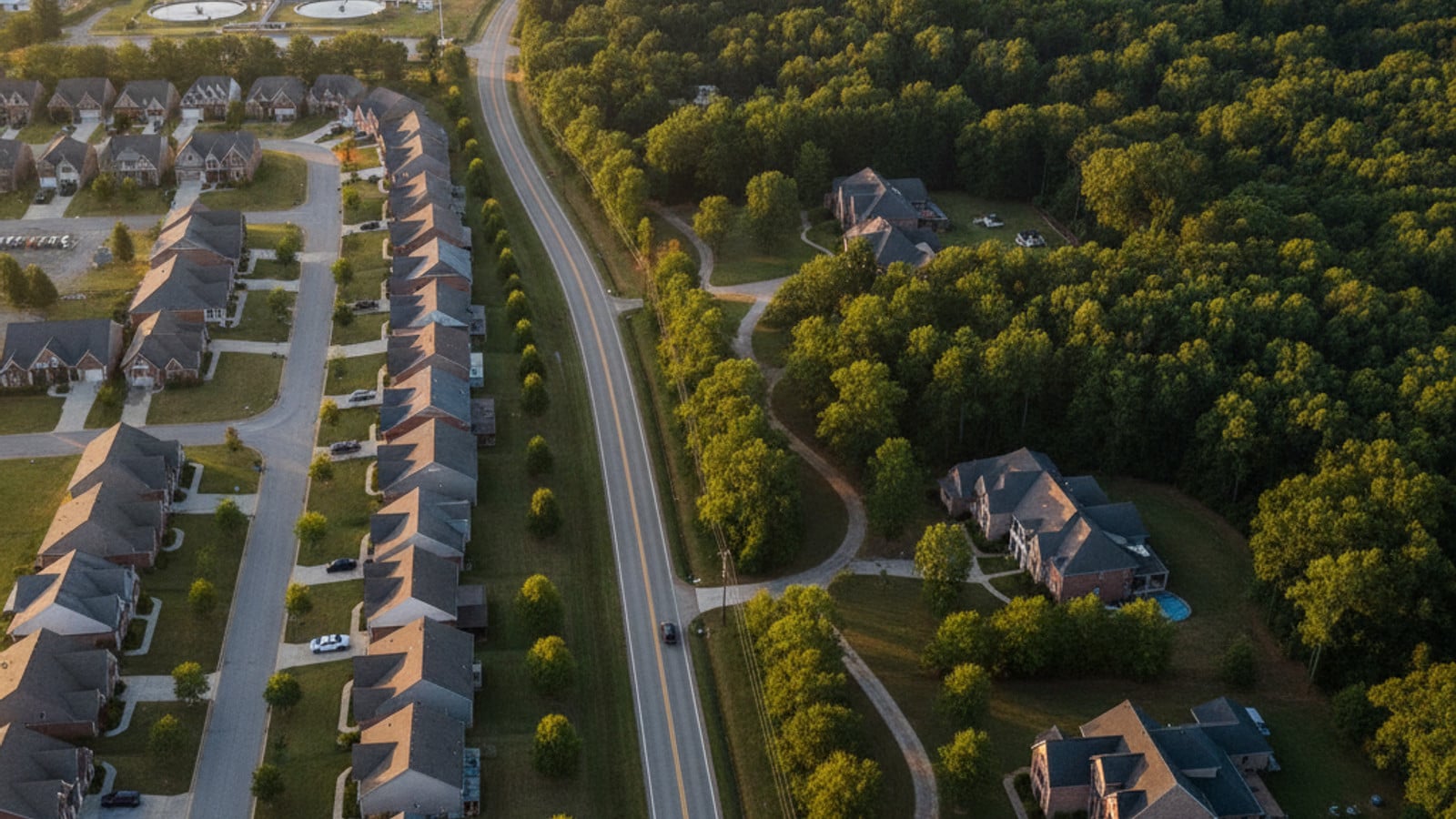
Living in Thompson's Station, TN often means adjusting to a more rural infrastructure. Buyers coming into this part of Williamson County often find themselves dealing with utility setups that look nothing like what they had back in a denser suburb or city neighborhood.
Water source is one of the bigger variables. Depending on lot size and location, a property either ties into the local municipal grid or runs entirely on a private well. That distinction shapes how you pay for water, what maintenance lands on your plate, and how you think about daily usage, so it's worth understanding before you make an offer.
City Water Versus Well Water in Williamson County
Homes on the municipal grid here are served by the H.B. & T.S. (Hillsboro, Burwood & Thompson's Station) Utility District. They treat the water, pump it to your house, and monitor it for safety compliance. You get a monthly bill tied to exactly how many gallons you use.
A private well works completely outside that system. You own the equipment, you pump groundwater directly from your land, and you're responsible for testing and treating whatever comes out of the ground. No monthly water bill, but the pump runs on electricity you pay for, and every maintenance call comes out of your pocket.
Which Water Source is More Common
As new subdivisions have pushed outward across Thompson's Station, municipal connections through the H.B. & T.S. Utility District have become standard for newer builds. Larger acreage properties and older lots outside the immediate town center are far more likely to still have private wells.
If you're shopping denser neighborhoods, expect city water. If you're looking at rural estates or older farmhouses, plan to see well systems, especially on lots where running municipal lines was never worth the cost.
Understanding Municipal Water and Private Wells
The phrase "city water well" trips up a lot of buyers, but it just means a municipal system that draws its supply from large, community-managed groundwater wells. The utility handles the extraction and treatment; finished, tested water shows up at your tap.
A true private well is different. It sits on your property, serves only your house, and the homeowner, not a utility, is on the hook for everything related to it. You don't pay per gallon to anyone, but you do pay to keep the thing running.
Types of Private Wells
Private systems generally fall into categories: dug, driven, bored, or drilled. Drilled wells go hundreds of feet down into bedrock to reach deep aquifers, which is why they're the standard for modern residential construction in this region.
Dug and driven wells are shallower, pulling from groundwater closer to the surface. You'll see them occasionally on historic properties, but they're more vulnerable to surface contamination and they can struggle during drought years.
How to Tell What You Have
The fastest way to spot a private well is to walk the yard and look for a well cap, a steel or plastic pipe coming a few inches out of the ground. Inside the house, a pressure tank in the basement, crawlspace, or garage is another clear sign.
If the property gets a monthly water bill from the H.B. & T.S. Utility District, it's on the municipal supply. A quick call to the district with the property address will confirm service status and any active accounts.
What Water Costs in Thompson's Station
The H.B. & T.S. Utility District runs a tiered rate structure. At heavy usage, anything above 20,001 gallons, the rate hits $13.10 per 1,000 gallons. Lower-tier rates vary, and you'll want to contact the utility directly to confirm current baseline pricing.
Separately, there's a wastewater usage fee to factor in. Effective July 1, 2025, that sewer fee runs $8.38 per 1,000 gallons, calculated off the metered water usage reported by HB&TS.
Well Ownership and Maintenance Costs
Well owners skip the monthly water bill entirely. What they pay instead is the electricity to run the pump, plus every maintenance cost that comes up, filters, softener salt, annual water testing. None of that is expensive on its own.
The painful part is when something fails. A well pump replacement can easily run into the thousands, and the cost climbs with the depth of the well. That's not a monthly expense, but when it hits, it hits hard.
What Runs a Water Bill Up the Most
On municipal water, outdoor irrigation is the fastest way to blow past the lower tiers. Watering a large lawn through a dry Tennessee summer pushes consumption up quickly, and once you're past 20,001 gallons, you're paying that $13.10 per 1,000-gallon rate on everything above that line.
Leaky toilets and dripping faucets matter more than most people think. Either one can waste thousands of gallons over a billing cycle. Fixing them is cheap; ignoring them shows up on your statement.
Health, Safety, and Water Quality
The H.B. & T.S. Utility District treats its supply to meet federal and state drinking water standards, monitoring for bacteria, heavy metals, and other contaminants before the water reaches your tap. That ongoing oversight is built into what you pay every month.
With a private well, that responsibility shifts entirely to you. The Williamson County Health Department handles well permitting, but once the well is in the ground and operating, the safety and quality of your water is your problem to manage.
Testing and Treating Your Water
Well water needs regular testing, at minimum once a year, and immediately if you notice any change in taste, odor, or color. Testing should cover coliform bacteria, nitrates, and whatever contaminants are relevant to your local geology.
Treatment is common in this area. Water softeners handle hard water minerals like calcium and magnesium, and a lot of homeowners add reverse osmosis systems or whole-house filtration units to improve taste and protect plumbing fixtures from sediment over time.
Pros and Cons of a Private Well
A well gives you direct control over your own water supply with no monthly usage fees attached to it. For buyers trying to keep fixed monthly costs down, that's genuinely appealing, especially on a property where water demand runs high.
The catch is what happens when the power goes out. A standard well pump runs on electricity, so an outage in Thompson's Station cuts your water off until power comes back or you're running a generator.
The Upside of Private Water
Well water skips the chlorine and other chemical treatments that municipal systems use. A lot of residents simply prefer how groundwater from their aquifer tastes compared to treated municipal supply.
There's also a real cost advantage if you're running a large garden or keeping livestock. You can use as much water as your well yields without watching the meter tick toward a higher pricing tier. On an expansive property, that adds up.
Downsides to Consider
Mechanical components fail. A broken pump or a collapsed well casing is a sudden, large expense, the kind that a homeowner on city water never has to think about. You can't budget for the timing, only for the likelihood.
Groundwater levels fluctuate with rainfall. During an extended dry stretch, a lower-yield well may not keep up with household demand, and the only real answer is to conserve and wait for the aquifer to recover.
Switching Between Water Sources
Getting a well-served property onto the municipal grid requires one thing first: the house has to be close enough to an existing H.B. & T.S. Utility District water main. If that main runs past your property line, you can apply for a tap and run a service line to the house.
If the nearest municipal lines stop miles away, extending them to a single rural property rarely makes financial sense for one homeowner. Distance is the deciding factor.
Costs and Feasibility of Connecting to the Grid
You'll pay tap fees, meter installation costs, and whatever it costs to run a service line from the street to the house. Those numbers vary depending on how far the main is and what the terrain looks like between there and your foundation.
Some properties end up running both systems, municipal water for drinking and indoor plumbing, well water for irrigation. That setup works, but it requires proper backflow prevention to make sure well water never crosses into the public supply.
Buying a Home with a Well in Thompson's Station
With roughly 118 homes currently on the market in Thompson's Station, buyers focused on rural properties will run into well systems regularly. One thing to know going in: a standard home inspection doesn't cover the mechanical health of a well or the quality of the water coming out of it.
You'll want a specialized well inspector during the due diligence period. That inspection confirms the well produces enough gallons per minute for your household, which is the most basic question a standard inspection simply won't answer.
What to Inspect Before Closing
A thorough well inspection looks at the pump's electrical draw, the pressure tank's condition, and the structural integrity of the well casing. The inspector will also pull a water sample for lab analysis.
Those lab results tell you whether the water has bacteria or elevated dissolved minerals. If treatment is needed, that's a negotiating point. You can ask the seller to install a filtration system before closing rather than inheriting the problem on day one.
Frequently Asked Questions
Who are the primary electricity and water providers for homes in Thompson's Station, TN?
The H.B. & T.S. Utility District provides municipal water to many homes in the area. Electrical providers vary by exact location within Williamson County, but the local power cooperative serves a large portion of the region.
How many days before closing should I schedule my utility transfers in Thompson's Station?
Contact the H.B. & T.S. Utility District and your power provider at least one to two weeks before closing. That gives the utilities enough time to schedule meter readings and get your new accounts set up.
What are the typical deposit fees required to open new residential utility accounts in the area?
Municipal utilities often charge a non-refundable setup fee or a refundable deposit depending on your credit history. Call the utility directly to confirm their current deposit requirements, those numbers can change.
Do homes in Thompson's Station typically connect to city sewer, or will I need to maintain a septic system?
It depends on the neighborhood. Denser subdivisions often connect to the town's sewer system, paying the $8.38 per 1,000 gallons wastewater fee, while rural properties and homes on larger lots typically rely on private septic systems.
How do sellers handle shutting off utilities without disrupting the buyer's final walk-through?
Sellers should schedule their utility disconnection for the day after the closing date. That keeps the lights and water on through the final walk-through and the signing.
Which high-speed internet and fiber options are currently available to Thompson's Station residents?
Internet availability depends on the specific address within Williamson County. Many neighborhoods have access to fiber-optic networks, while more rural lots may rely on satellite or fixed wireless connections.
Check out this article next