


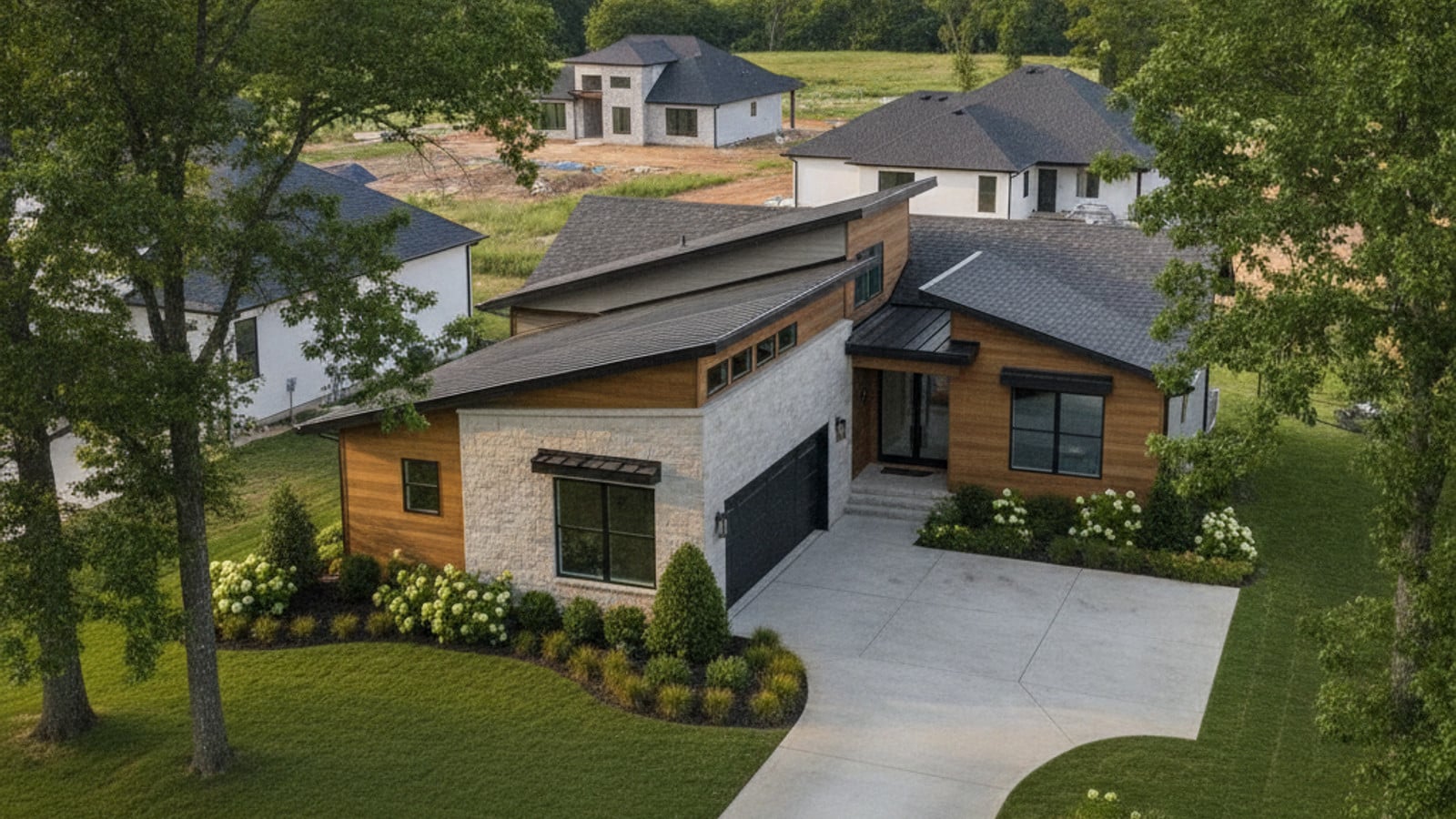
Williamson County keeps pulling buyers in - the space, the amenities, the Nashville access. Many buyers find themselves drawn to living in Thompson's Station. If you've narrowed things down to this part of the map, you've probably already figured out that Thompson's Station and Franklin are the two names that come up most.
Picking between them isn't complicated, but it does require being honest with yourself about three things: how much you want to spend, how much of a commute you'll actually tolerate, and how much retail and infrastructure you need close by. The towns are neighbors, but they're not the same place.
Real Estate Market Comparison
The price gap between these two towns is real and consistent. Franklin carries a premium that reflects its size, its commercial infrastructure, and its longer track record as a destination - Thompson's Station is newer to the game and priced accordingly.
Beyond sticker price, the pace of each market tells a different story. Inventory levels and days on market move independently on either side of that town line, so don't assume what's true in one place applies to the other.
Home Prices and Property Types in Thompson's Station
As of mid-2026, the median sale price in Thompson's Station is roughly $890,000. Homes are averaging 61 days on market before going under contract - not a fire sale pace, but steady. You're looking at about 118 active listings, which works out to a 4.1-month supply of inventory. Sellers are holding firm on price, with homes closing at an average of 99.5% of list.
Home Prices and Property Types in Franklin
Franklin runs higher. The median home price falls somewhere between $925,000 and $1,050,000 depending on neighborhood and property type, and a rolling 12-month analysis through June 2026 put the countywide median at $925,000 across 2,131 closed sales. Some single-month snapshots push that figure north of $1.1 million.
The established subdivisions and luxury estates here draw consistent demand, and the market reflects that. If you're budgeting against the lower end of Franklin's range, be prepared for the upper end to show up in your searches.
Property Taxes and Cost of Living
Purchase price is the headline number, but it's not the whole budget. Once you're in the house, you're also writing checks for property taxes, municipal fees, and any HOA dues - and those recurring costs can shift the comparison between these two towns more than buyers expect.
The baseline is identical for both: same county, same county rate. The difference shows up in the municipal layers each town adds on top.
Property Taxes in Thompson's Station
Thompson's Station doesn't run its own tax billing - residents pay through the Williamson County Trustee's Office. For the 2026-2027 fiscal year, the county rate is $1.30 per $100 of assessed value. The town's own municipal levy for 2026 adds $0.103 per $100 of assessed valuation on top of that. Compared to denser cities in the region, the overall burden here stays relatively modest.
Property Taxes in Franklin
Franklin homeowners pay the same $1.30 county rate, then layer on a higher municipal rate. Following a recent county-wide reappraisal, Franklin's city rate moved to $0.296 per $100 of assessed valuation for 2026.
Worth putting in context: even at that rate, Franklin holds the lowest property tax rate of any Tennessee city with a population over 50,000. Still, you'll want to run your specific target price through these numbers before you commit to an escrow estimate.
Commute Times and Transportation Logistics
Both towns funnel onto I-65 to get to Nashville. Your commute experience will depend entirely on where along that corridor you land - and whether you're willing to build an extra cushion into your morning.
Rush hour on I-65 is not theoretical. Buyers who only test-drive a route on a Saturday are in for a rude awakening come Tuesday morning.
Getting Around Thompson's Station
Thompson's Station sits roughly 25 to 30 miles south of downtown Nashville. The Columbia Pike corridor anchors most of the development, and I-65 is essentially your only option for regional travel. Off-peak, you're looking at 35 to 40 minutes into the city. When congestion stacks up near Brentwood and downtown during rush hour, that stretches to a full hour. There's no public transit serving the town - this is a car-dependent location, full stop.
Getting Around Franklin
Cool Springs puts you 18 to 24 miles from downtown Nashville. Off-peak, the drive runs 20 to 30 minutes. Rush hour pushes it to 40 or 50 minutes - still better than what Thompson's Station drivers deal with, but not nothing.
Franklin also gives you options beyond your own car. The Franklin Transit Authority runs local routes, the WeGo 95 Spring Hill Express makes morning and evening stops in town, and a new airLINE shuttle now connects the Cool Springs area directly to Nashville International Airport. If any of that matters to you, it only exists in one of these two towns.
Parks, Recreation, and Local Amenities
The gap in commercial development between these two towns is probably the starkest difference on this list. Franklin has major retail infrastructure - malls, mixed-use districts, entertainment venues. Thompson's Station has a quieter, more inward-looking setup built around master-planned communities.
Both prioritize green space and trails. That part's comparable. Where they diverge is how much you want a big-box shopping center or a concert venue reachable in five minutes.
Amenities in Thompson's Station
Recreation centers on public spaces like Sarah Benson Park and Preservation Park, with walking trails and open fields. Commercial activity lives inside the master-planned communities themselves - Tollgate Village and Bridgemore Village weave local shops and restaurants directly into their residential layouts rather than clustering them in a separate retail corridor. That footprint is set to grow: a major luxury mixed-use development called Sagefield is scheduled to break ground in late 2026.
Amenities in Franklin
Cool Springs is Franklin's commercial anchor - a massive district built around the CoolSprings Galleria mall, now supplemented by the $125 million McEwen Northside project adding walkable retail, offices, and apartments. That's the modern side of town.
On the other end, Franklin's historic downtown district holds its own with independent shops and restaurants. And residents have quick access to larger entertainment draws like the FirstBank Amphitheater and Arrington Vineyards.
Frequently Asked Questions
How much cheaper are homes in Thompson's Station, TN compared to Franklin?
Thompson's Station's median sale price sits at roughly $890,000 as of mid-2026. Franklin's median generally ranges from $925,000 to $1,050,000. Depending on what you're buying and where, buyers can often save tens of thousands of dollars by going with Thompson's Station.
How much longer is the commute to Nashville from Thompson's Station versus Franklin?
Plan on roughly 10 to 15 extra minutes each way compared to Franklin. During rush hour, the drive from Thompson's Station to downtown Nashville can run up to an hour. From Franklin's Cool Springs area, that same rush-hour trip takes about 40 to 50 minutes.
Do Thompson's Station residents get zoned for the same Williamson County schools as those in Franklin?
Both towns are in Williamson County, but school assignments are based on the district's specific zoning maps - not town lines. You'll want to pull up the district's official boundary map for any specific address before assuming which school a house is zoned for.
Are property taxes lower in Thompson's Station, TN than in the city limits of Franklin?
Yes. Thompson's Station's town levy for 2026 is $0.103 per $100 of assessed valuation. Franklin's city rate is $0.296. Both towns sit on top of the same Williamson County base rate of $1.30.
What major amenities do you give up by choosing to buy a house in Thompson's Station over Franklin?
Direct access to the CoolSprings Galleria and the $125 million McEwen Northside project, for starters. You also lose the public transit options Franklin offers through the Franklin Transit Authority. Thompson's Station replaces those with smaller, integrated commercial spaces inside its master-planned communities - it's a different model, not necessarily a lesser one, but the trade-off is real.
Is Thompson's Station getting its own commercial center, or do residents still rely on downtown Franklin for shopping and dining?
There's already retail built into communities like Tollgate Village and Bridgemore Village. And Sagefield, a major luxury mixed-use development, is scheduled to break ground in late 2026. For now, though, if you need a mall, you're driving to Franklin.
Check out this article next